
For decades, if you wanted to know the real core temperature of a critically ill child in the ICU, you had exactly one category of options: stick something inside them. Esophageal probes. Bladder catheters. Rectal thermometers. All highly accurate, all deeply unpleasant, and all carrying their own risks of infection and tissue damage in the tiniest, most vulnerable patients. The idea that you could slap a sensor on a kid's forehead and get the same precision? Laughable. Like bringing a pool noodle to a sword fight.
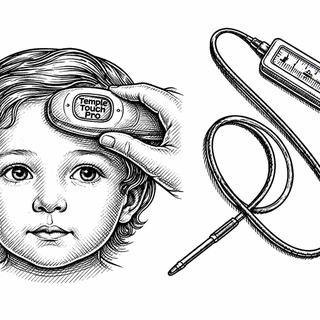
And yet, here we are. A new clinical trial - NCT07507396 - is putting that exact premise to a formal test, asking whether the Temple Touch Pro (TTP) can hold its own against invasive gold standards in pediatric intensive care patients who need targeted temperature management. Let's pump the brakes and take a closer look.
What Is Targeted Temperature Management, and Why Does Precision Matter So Much?
Targeted temperature management (TTM) - formerly known as therapeutic hypothermia - is one of the more remarkable tools in critical care medicine. The basic idea: deliberately cooling (or carefully maintaining) a patient's body temperature within a narrow therapeutic window to protect the brain after events like cardiac arrest, traumatic brain injury, or hypoxic-ischemic encephalopathy (HIE) in newborns.
In adults, landmark studies have demonstrated the neuroprotective benefits of TTM following cardiac arrest. In pediatrics, the THAPCA trial (Therapeutic Hypothermia After Pediatric Cardiac Arrest) explored similar territory, finding that while hypothermia didn't significantly improve outcomes over normothermia in children with out-of-hospital cardiac arrest, precise temperature control remained the key variable in both arms (Moler et al., 2015, NEJM; DOI: 10.1056/NEJMoa1411480).
Here's the thing that makes temperature monitoring in TTM so unforgiving: we're often talking about a target window of just 1-2 degrees Celsius. Drift too cold and you risk coagulopathy, arrhythmias, and infection. Drift too warm and you lose the neuroprotective benefit entirely. In a tiny pediatric patient, even half a degree of measurement error can mean the difference between the therapeutic sweet spot and a danger zone. This isn't "does the kid have a fever?" territory. This is "we need accuracy to the tenth of a degree, continuously, for hours or days."
So you can see why ICU teams have historically been reluctant to trust anything that doesn't involve a probe physically sitting next to the organ it's trying to measure.
The Temple Touch Pro: Not Your Drugstore Forehead Scanner
Before anyone dismisses this as another infrared forehead thermometer - the kind your office building used during the pandemic with all the reliability of a magic 8-ball - the Temple Touch Pro operates on a fundamentally different principle called zero-heat-flux (ZHF) technology.
The concept is wonderfully clever. A ZHF sensor placed on the skin actively heats the surface beneath it until there is zero temperature gradient between the skin and the sensor. At that point, the temperature at the skin surface equals the core temperature beneath it, because heat has stopped flowing outward. You've essentially turned a patch of skin into a window to the body's core temperature.
Studies in adult surgical and ICU populations have shown promising agreement between ZHF devices and invasive core temperature measurements. Eshraghi et al. demonstrated good accuracy in cardiac surgical patients (Eshraghi et al., 2014, Anesth Analg; DOI: 10.1213/ANE.0000000000000278), and Kimberger and colleagues found strong correlation with pulmonary artery catheter readings (Kimberger et al., 2009, Br J Anaesth; DOI: 10.1093/bja/aep134).
But - and this is where my skeptic alarm starts chirping - adults are not children, and stable surgical patients are not hemodynamically unstable PICU patients on active temperature management protocols. Pediatric patients have different surface-area-to-mass ratios, thinner skin, and often wildly different perfusion states. A sensor calibrated against an adult forehead may behave very differently on a three-year-old who's peripherally vasoconstricted during a cooling protocol.
What This Trial Needs to Prove
The trial record tells us this is an evaluation of the Temple Touch Pro specifically in PICU patients requiring targeted temperature control. That's a deliberately tough testing ground, and I respect the choice. If you want to prove your non-invasive thermometer can play in the big leagues, you don't validate it against a resting adult in a warm room - you throw it into the hardest scenario you can find.
For this trial to be convincing, we'll want to see a few things:
Bland-Altman analysis with tight limits of agreement. The standard way to compare measurement methods. A correlation coefficient alone is meaningless here. Two thermometers can be beautifully correlated and still systematically off by a full degree. We need the bias (mean difference) to be near zero and the 95% limits of agreement to be clinically acceptable - ideally within ±0.3°C for TTM applications.
Performance during temperature transitions. It's one thing to agree at a stable 33°C. It's another to track accurately during active cooling and rewarming phases, when temperatures are changing rapidly. ZHF devices can have a thermal lag because they need time to re-establish equilibrium. In TTM, that lag could mean missing a critical overshoot.
Subgroup analysis by age and weight. A six-month-old and a sixteen-year-old are basically different species, physiologically speaking. The device needs to work across the pediatric spectrum, or we need to know exactly where it doesn't.
Why This Matters Beyond the ICU
If the Temple Touch Pro proves reliable in this extreme scenario, the implications ripple outward. Non-invasive continuous temperature monitoring could reduce line-associated infections, decrease patient discomfort, simplify nursing workflows, and potentially make TTM feasible in resource-limited settings where invasive monitoring infrastructure isn't available.
There's also a more subtle benefit: continuous non-invasive monitoring could catch temperature deviations faster than intermittent rectal or axillary checks, which is the reality in many PICUs that lack the staffing for dedicated one-to-one nursing. A sensor that just sits there, quietly reading core temperature and alarming when things drift, is the kind of boring-but-transformative technology that actually saves lives.
Recent work by Carney et al. has highlighted the broader push toward non-invasive monitoring in pediatric critical care, noting that reducing invasive device burden is particularly impactful in children, where every additional line or probe carries proportionally greater infection risk (Carney et al., 2022, Pediatr Crit Care Med; DOI: 10.1097/PCC.0000000000002853).
The Constructive Skeptic's Take
I genuinely hope this trial delivers strong results. The clinical need is real, and the physics behind ZHF technology is sound. But I've seen enough "promising" monitoring devices stumble at the validation stage to know better than to pop the champagne early.
The pediatric critical care population is notoriously difficult to study - small sample sizes, heterogeneous conditions, and ethical constraints around consent and procedures. If this trial is adequately powered and uses the right statistical framework (please, not just Pearson's r), it could provide genuinely useful data regardless of which direction the results point.
Because here's the thing: a well-designed trial that shows the device doesn't perform adequately during active cooling would be just as valuable as one that validates it. We need to know either way. The worst outcome isn't a negative result - it's an underpowered study with ambiguous conclusions that leaves clinicians guessing.
So we'll watch, we'll wait, and we'll read the Bland-Altman plots with the intensity of a caffeinated squirrel studying an acorn. Science is a process, not a press release.
Disclaimer: This blog post is for informational and educational purposes only and does not constitute medical advice. Clinical trial information is based on publicly available records and may be updated as the study progresses. Always consult qualified healthcare professionals for medical decisions.
Clinical Trial Reference: NCT07507396 - Non-invasive Temperature Monitoring in Pediatric Intensive Care Patients Requiring Targeted Temperature Management: Evaluation of Temple Touch Pro