
What if you could fire an enzyme through a plasma jet, land it on a surface in one step, and somehow not destroy the very thing that makes it useful? That seems to be the question behind this study. It is a fair question, too. Enzymes are famously talented and occasionally fussy, like tiny molecular divas with excellent work ethic and poor tolerance for rough handling.
The paper centers on glucose oxidase, an enzyme often used in glucose sensing, and a technique called aerosol-assisted plasma deposition, or AAPD. The researchers report something notable: they were able, for the first time, to deposit glucose oxidase in a poly(ethylene oxide), or PEO, film using a single-step atmospheric pressure plasma process. Better still, the enzyme stayed active. Not merely present. Not technically somewhere in the coating. Active.
That matters because building biosensors is often a balancing act between function and fragility. You want the enzyme fixed in place on a device surface, but you do not want to immobilize it so enthusiastically that it stops doing chemistry.
Why glucose oxidase matters
Glucose oxidase is one of the workhorses of biosensing. It reacts with glucose, and that reaction can be translated into a measurable signal. This basic idea sits behind many glucose-detection systems, especially in research and diagnostics.
The problem is not usually finding an enzyme that can detect glucose. Nature solved that part some time ago. The problem is integrating that enzyme into a practical material. It has to stick to a surface. It has to survive fabrication. It has to keep working in messy environments. And ideally, the method for making it should not require a parade of separate chemical steps and delicate handling.
This is where AAPD enters the scene.
A plasma jet with a gentler touch
Plasma sounds dramatic because it is. It is an ionized gas, and in many contexts it is used to modify surfaces or create thin coatings. That can be useful, but also risky when biomolecules are involved. Enzymes do not generally enjoy being blasted with energetic conditions. One can imagine them filing a complaint.
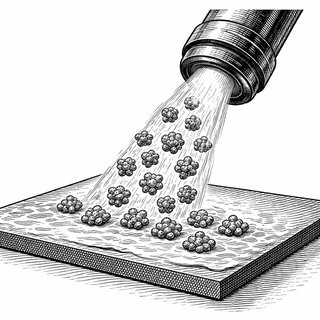
In this study, the researchers used an atmospheric pressure plasma jet together with an aerosol. That aerosol carried the enzyme and the polymer precursor, allowing the team to create a biocomposite film in a single step. The result was a coating that combined glucose oxidase with PEO.
PEO is doing important work here. Think of it as a protective matrix, a kind of soft landing pad and structural host for the enzyme. The goal is not just to trap glucose oxidase in plastic-like material, but to do so in a way that preserves access to glucose and keeps the enzyme functional.
That single-step aspect is especially attractive. Biosensor fabrication can become a small festival of coating, linking, washing, and hoping. Collapsing some of that into one deposition step could simplify manufacturing and reduce opportunities for damage or inconsistency.
The interesting part: the enzyme still worked
The central result is straightforward and strong: the deposited GOx/PEO films retained enzymatic activity and showed excellent sensitivity for glucose sensing.
That is the line that makes the whole paper more than a technical curiosity. Plenty of deposition methods can make a film. The hard part is making a film that still behaves like a biosensor rather than a memorial to a once-lively enzyme.
The researchers also tested glucose sensing in cell culture medium containing 10% fetal bovine serum, which is a much messier setting than a neat laboratory buffer. Serum is full of proteins and assorted biochemical clutter. If your sensor can perform there, it has passed a more interesting test than merely behaving on its best day.
This does not mean the technology is ready to leap directly into every clinic, wearable patch, or bioreactor tomorrow morning. It does mean the concept survives contact with a more realistic biological environment, and that is a meaningful step.
Tiny droplets, big consequences
One of the more elegant findings in the paper involves water evaporation during aerosol transport. The researchers found that evaporation strongly influences the final film morphology.
That may sound like a dry processing detail, but it is not. The shape and internal structure of a biosensor coating can determine how well analytes reach the enzyme, how stable the material remains, and how reproducible the sensor is from one sample to the next.
In simple terms, the droplets change as they travel. As water evaporates, the contents become more concentrated, and that affects how the enzyme and polymer end up arranged on the surface. A droplet arriving relatively dry is not the same creature as a droplet arriving wet. Same passport, different attitude.
Why is that useful? Because morphology is not cosmetic. It is performance. If engineers can tune how much evaporation happens before the droplets land, they may be able to tune how the sensing film forms, and therefore how well it works.
Why this is interesting beyond glucose
At one level, this is a glucose-sensor paper. At another, it is a methods paper with wider implications. If AAPD can deposit a delicate enzyme in a functional polymer matrix while preserving activity, that opens the door to broader enzyme-based biosensor design.
Many biosensors rely on biomolecules that are powerful but temperamental. Immobilizing them without ruining them is a recurring problem in bioengineering. A one-step deposition technique that works under atmospheric pressure, uses a plasma jet, and can be applied to different substrates is the sort of platform idea that gets people thinking beyond the first application.
That could matter for tissue engineering, point-of-care diagnostics, lab-on-a-chip devices, and sensors used in complex biological media. The paper does not claim to solve all of that. Sensibly. Science is hard enough without issuing movie trailers. But it does suggest a fabrication route that may be more versatile than many conventional immobilization strategies.
The real-world promise, and the real-world caveats
If follow-up work goes well, this kind of deposition method could help make biosensors that are easier to manufacture and better suited to real biological settings. That is the practical appeal. A simpler production process can reduce cost, improve consistency, and make it easier to adapt sensor coatings to different surfaces.
There are still obvious next questions. How stable are these films over long periods? How reproducible are they across large batches? How do they perform against established commercial sensor materials? Can the same method handle other enzymes just as well, or was glucose oxidase being unusually cooperative that day?
Those questions matter because early technical success does not automatically become a robust product. Many elegant lab methods discover, sooner or later, that scale-up is an unforgiving editor.
Still, this study addresses a real bottleneck. It shows that plasma-based deposition does not have to be the villain in every biomolecule story. Under the right conditions, it can be part of a fairly clever delivery system.
A small step for a coating, a useful one for biosensing
The charm of this paper is that it tackles a very practical problem with a method that sounds slightly futuristic and then backs it up with functional sensing data. The researchers did not just make a film. They made a film that kept the enzyme alive enough to do its job in a biologically relevant medium.
That is the sort of advance biosensor research often needs: not a miracle, not a hype balloon, just a better way to bring sensitive biology and hard materials into the same room without anyone throwing a chair.
For anyone interested in how diagnostics and biointerfaces are built, this is a neat example of engineering restraint paying off. Sometimes progress looks less like a revolution and more like learning how to land the fragile cargo intact.
This blog post discusses research findings and should not be taken as medical advice. If you have concerns about blood glucose monitoring or metabolic health, please consult a healthcare provider. Research discussed here represents ongoing scientific investigation and clinical validation is still in progress.
All images used in this post are decorative illustrations only and do not represent or reflect the accuracy, reality, or correctness of the referenced research.
Primary Source: Single-Step Aerosol-Assisted Plasma Deposition of Biocomposite Glucose Oxidase/Poly(ethylene oxide) Films for Biosensing Applications. PubMed record 42021452. Source