
Once upon a time in a lab not so far away, a humble plant-based polymer walked into the biomaterials world with big dreams and one recurring problem: it was great at holding water, but not always great at holding itself together. Then the scientists got clever. Instead of asking cellulose hydrogels to be either soft or strong, they built a structure that tries to be both - and the result looks a lot more like a platform technology than a chemistry demo.
That is what makes this paper interesting. The researchers describe a dual cross-linked cellulose hydrogel engineered through a synergy of entanglements and cross-links, producing a material that is both tough and stretchable while still carrying a very high water content. In plain English, they figured out how to make a mostly-water, cellulose-based gel behave less like fragile jelly and more like something you could plausibly build products around.
Why hydrogels are such a big deal
Hydrogels have been on the commercial radar for a while because they check a lot of boxes people care about in medicine and advanced materials. They are flexible, hydrophilic, and often biocompatible. That makes them appealing for artificial tissues, wearable or flexible electronics, wound care, and structural biomaterials.
The catch is that hydrogels often force an unpleasant tradeoff. If you want them soft and wet, they can become weak. If you want them stronger, you can lose the squishy, tissue-like behavior that made them interesting in the first place. It is the materials science version of wanting a race car that is also a pickup truck.
Cellulose adds another twist. It is sustainable, abundant, and attractive from a manufacturing and cost perspective. Investors like words like "renewable feedstock." Product teams like materials that do not sound like they came from a villain origin story. But crystalline polysaccharide hydrogels such as cellulose-based ones are hard to toughen because their high water content limits energy dissipation mechanisms. In less academic language, when stress hits the material, there are only so many ways for that energy to be absorbed without the whole thing failing.
What this team actually built
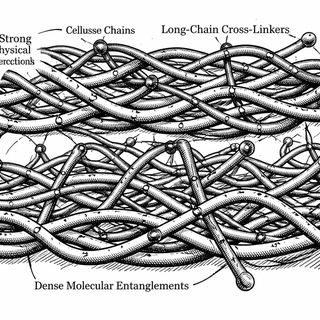
The core idea here is hierarchy. The hydrogel is not relying on a single kind of bonding or a single structural trick. Instead, it combines strong physical interactions between cellulose chains with dense molecular-scale entanglements involving both cellulose chains and long-chain chemical cross-linkers.
That combination leads to an intertwined nanofibrillar architecture and a high content of cellulose II crystalline hydrates across nano- and micro-scales. The layered structure matters because different features can contribute different mechanical jobs. Some parts help the gel hold together. Some help it deform without snapping. Some help spread out stress instead of letting one weak point ruin everyone's day.
The reported water content is still very high, ranging from 72 percent to 82 percent. That is one of the reasons the numbers stand out. According to the summary, the material reached maximum tensile strength of 9.5 ± 2 MPa, tensile strain of 267 ± 18%, and work of fracture of 11.7 ± 0.3 MJ/m³.
Those are not "pretty good for a hydrogel" numbers. Those are "okay, now we should start thinking about actual use cases" numbers.
Why this matters commercially
This is the part where my founder brain starts pacing the room.
If a cellulose hydrogel can be made tough, stretchable, and water-rich at the same time, the market conversation changes. Instead of pitching hydrogels as delicate specialty materials, you can start positioning them as practical components for products that need softness plus durability.
A few obvious lanes show up immediately:
Tissue engineering and regenerative medicine
Artificial tissue scaffolds need to live in a mechanically demanding environment. A material that better mimics hydrated tissue while resisting tearing has obvious appeal. If it also comes from a sustainable cellulose platform, that creates a cleaner story for scale-up and supply chain planning.
Flexible electronics and biointerfaces
Wearable sensors and soft electronic systems need materials that bend and stretch without failing. A hydrogel with this sort of mechanical profile could be interesting as a substrate, interface layer, or structural support material in devices designed to sit on or near the body. Soft hardware has a nasty habit of becoming hard to manufacture. Stronger hydrogels could help reduce that pain.
Structural biomaterials and wound-related applications
There is a whole class of products that need to be moist, conformable, and mechanically reliable. Think dressings, patches, implants, and other soft biomedical components. The phrase "structural biomaterial" is where things get commercially spicy, because structure means load-bearing or shape-preserving functions, and that usually commands more value than simply being a passive gel.
The scientific trick worth watching
What I like most here is that the paper is not selling magic. It is selling architecture.
The performance seems to come from using multiple reinforcing mechanisms at once: physical interactions, chemical cross-linking, molecular entanglement, and crystalline organization. That is often what separates a publishable material from a usable one. Real products survive because they have backup systems. Nature does this constantly. Tendons, cartilage, skin - none of them rely on one cute trick and a prayer.
From a business perspective, that raises a good question: can this hierarchical design strategy be generalized? If yes, this paper is not just about one hydrogel recipe. It could point toward a design framework for a broader class of sustainable soft materials.
That is where platform value lives.
The reality check
Before anyone starts ordering branded cellulose-gel prototypes and naming the startup after a forest animal, there is still work to do.
Strong lab performance does not automatically translate into manufacturability, repeatability, sterilization compatibility, shelf stability, regulatory acceptance, or cost-effective processing. Those are the usual boss battles. Mechanical metrics are necessary, but the commercial world also wants predictable fabrication and long-term behavior under real conditions.
There is also the application-specific question. A great material for tissue engineering may need different properties than one meant for flexible electronics. So this is not one product yet. It is a strong enabling material that could feed several product categories if follow-up development succeeds.
Still, that is exactly how valuable materials stories often begin. First the performance ceiling moves. Then engineers start building around it.
Why I think this paper deserves attention
A lot of sustainable materials research sounds noble but commercially vague. This one feels more concrete. It tackles a real bottleneck - how to make cellulose hydrogels strong and tough without giving up the water-rich, flexible nature that makes hydrogels useful.
That is why this paper matters. It suggests cellulose, a familiar and renewable material, may be able to graduate into higher-performance biomedical and soft-device roles than many people would have guessed. If that happens, the winner is not just the lab. The winner is every company trying to build soft, durable, biocompatible products without leaning entirely on more expensive or less sustainable material systems.
And yes, I realize getting excited about polymer entanglements is a niche hobby. But some of the best businesses start when a niche problem quietly stops being a problem.
This blog post discusses research findings and should not be taken as medical advice. If you have concerns about biomaterials, tissue engineering, or related medical technologies, please consult a qualified healthcare professional or relevant specialist. Research discussed here represents ongoing scientific investigation and clinical validation is still in progress.
All images used in this post are decorative illustrations only and do not represent or reflect the accuracy, reality, or correctness of the referenced research.
Primary Source: Tough and stretchable cellulose hydrogels engineered via the synergy of entanglements and cross-links. PubMed Record 41679833. https://pubmed.ncbi.nlm.nih.gov/41679833/