
Forget everything you think you know about air testing - because the future of spotting dangerous bacteria in the air may look less like a giant lab setup and more like a clever color-changing system that quietly does the hard work for us. The study behind this idea takes a familiar public health headache, namely the fact that airborne germs often show up in tiny amounts, and tackles it with a device that collects them, concentrates them, and then makes their presence easier to see. It is a bit like trying to find one glitter speck in a gymnasium, then inventing a way to sweep it into a teaspoon and make it glow.
From a health equity perspective, that matters a lot.
Communities with fewer resources often carry a heavier burden when it comes to poor ventilation, crowded housing, aging public buildings, and delayed detection of infectious threats. If we ever want cleaner, safer indoor spaces in schools, shelters, clinics, transit hubs, and workplaces, we need tools that are not just scientifically smart, but practical. This new biosensing platform points in that direction.
Why airborne bacteria are so hard to catch
Airborne pathogens are sneaky. They are diluted in huge volumes of air, which means you can sample for a while and still end up with only a tiny number of organisms in your collection liquid. That makes detection harder, slower, and sometimes less reliable.
This is not a small technical annoyance. It is one of the big reasons environmental monitoring can be challenging in real-world settings. If your signal is weak, you either need more time, more equipment, or more complicated processing. Public health teams do not always have the luxury of all three.
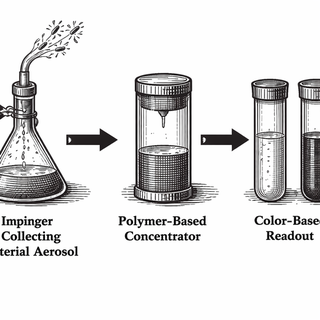
That is where this study gets interesting. The researchers built an integrated system that does three jobs in sequence:
- It collects bacterial aerosols from air into liquid.
- It concentrates that liquid sample.
- It generates a visible color-based readout to show whether target bacteria are present.
Instead of treating those as separate chores that require multiple handoffs, the platform links them together. That kind of streamlining may not sound glamorous, but in public health, glamorous is overrated. Useful wins.
The smart part: making a tiny signal bigger
The researchers started by collecting bacterial aerosols into liquid using an impinger. Then came the concentration step, which is the star of the show.
They used a self-driven superabsorbent polymer-based concentrator combined with a membrane. Superabsorbent polymers are materials that soak up water enthusiastically, like the overachiever in a group project. In this setup, that property helped shrink the volume of the collected liquid sample and concentrate the bacteria inside it.
According to the study summary, the system achieved a 20-fold concentration in 20 minutes. For a detection workflow, that is meaningful. If the original sample is too dilute to read clearly, concentrating it can move the target into a more detectable range without requiring a giant machine or a painfully long wait.
That has obvious appeal for indoor air surveillance. The faster we can go from “maybe something is there” to “yes, we detected it,” the more useful the information becomes.
Then comes the color trick
After concentration, the researchers labeled the target bacteria with immune Pd/Pt nanozymes. Nanozymes are nanomaterials that behave a bit like enzymes, helping trigger chemical reactions. In this case, they amplified the signal.
Once the bacteria-nanozyme complexes were captured on the membrane and unbound material was washed away, the immobilized nanozymes catalyzed a color-producing reaction. In plain English: if the target bacteria were there, the chemistry made that fact easier to see.
Colorimetric systems have a real advantage for broader access because they do not always require highly specialized readout equipment. A visible change can support simpler workflows and potentially lower barriers to use. That does not mean every color-based biosensor is automatically ready for every clinic or community site, of course. But the general direction is promising, especially where advanced laboratory infrastructure is limited.
Why this could matter for underserved communities
As someone who thinks about health equity all the time, I keep coming back to where tools like this could matter most.
Airborne pathogen monitoring is not only a problem for high-tech research buildings. It matters in places where people may already face overlapping risks, including under-resourced schools, long-term care settings, community health centers, emergency shelters, correctional facilities, and densely occupied housing. These are environments where delayed recognition of microbial hazards can hit hardest.
A detection platform that is faster and more effective at handling low-concentration airborne bacteria could eventually support:
- Earlier warning of indoor contamination
- Better environmental monitoring in high-risk shared spaces
- More targeted responses instead of broad guesswork
- Wider access to surveillance tools outside elite lab settings
That last point is especially important. Public health innovation too often starts with shiny prototypes that work beautifully in controlled environments and then fall apart when budgets, staffing, and infrastructure enter the chat. If follow-up development can keep this system affordable, robust, and simple to operate, it could help narrow that gap rather than widen it.
What problem this research is trying to solve
At its heart, this study addresses a very practical bottleneck: low airborne pathogen concentration.
You can have excellent detection chemistry, but if there is barely anything in the sample, your test is stuck trying to perform miracles with crumbs. By integrating aerosol collection, passive enrichment, and signal amplification, the platform tries to fix the weak-link problem at multiple stages.
That is a thoughtful design choice. Instead of obsessing over only the final readout, the researchers improved the path leading up to it. In public health systems, that kind of thinking usually pays off. A test is only as strong as its messiest step.
A reality check before we all start high-fiving the ventilation system
This research is exciting, but it is still research.
We do not yet know from the summary alone how the platform will perform across varied real-world environments, bacterial species, humidity conditions, contamination loads, or routine field use. There are also practical questions about cost, durability, training needs, and whether the method can be adapted for broader pathogen panels. A strong proof of concept is not the same as widespread deployment.
And while rapid detection is valuable, detection alone does not fix the structural issues that make communities vulnerable in the first place. Cleaner air also depends on investments in ventilation, maintenance, occupational protections, and equitable public health infrastructure. No sensor can single-handedly substitute for good policy. If only.
The bigger picture
Still, I find this work genuinely encouraging. It reflects the kind of innovation public health needs more of: not just “can we detect something?” but “can we detect it faster, more efficiently, and in a way that might one day be useful where need is greatest?”
If future studies confirm the platform’s performance and support practical implementation, this type of biosensor could help reshape how we monitor indoor air for bacterial threats. That would be good science and good public health.
Sometimes progress looks dramatic. Sometimes it looks like a membrane, a polymer, a nanozyme, and a color change doing quiet hero work in the background. Honestly, I will take that.
This blog post discusses research findings and should not be taken as medical advice. If you have concerns about airborne infectious exposures or indoor environmental health, please consult a healthcare provider or qualified public health professional. Research discussed here represents ongoing scientific investigation and clinical validation is still in progress.
All images used in this post are decorative illustrations only and do not represent or reflect the accuracy, reality, or correctness of the referenced research.
Primary Source: A Colorimetric Biosensor Integrated with a Self-Driven Superabsorbent Polymer-Based Concentrator for Effective Concentration and Rapid Detection of Bacterial Aerosols. PubMed. https://pubmed.ncbi.nlm.nih.gov/41945760/