
*By No treadmills, no blood draws, no fasting since midnight. Just... nap. With electrodes on your head. In Wisconsin.
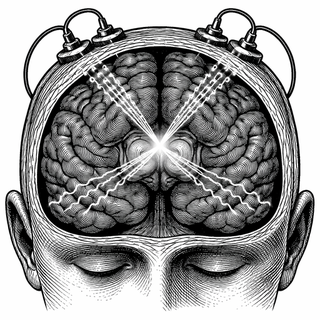
A new study (NCT07498270) out of Dane County, Wisconsin is recruiting up to 24 healthy volunteers to spend three overnight visits getting their brains gently tickled by a technique called temporal interference transcranial electrical stimulation - or TI-TES, for those of us who value our breath. The researchers want to know whether this non-invasive stimulation can tweak sleep spindles, those rhythmic bursts of brain activity in the 8-16 Hz range that your thalamus produces while you're blissfully unconscious.
And honestly? The engineering behind this is one of the most clever things happening in neurostimulation right now.
What Are Sleep Spindles and Why Should You Care?
Think of sleep spindles as your brain's overnight filing system. While you're drooling on your pillow, your thalamus - a walnut-sized relay station deep in your brain - fires off rapid bursts of electrical activity that help consolidate memories. It's like your brain is a short-order cook during the day, frantically plating dishes as orders come in, and then at night it finally gets to organize the walk-in cooler.
Research has firmly established that these spindles play a significant role in transferring information from short-term to long-term memory storage (Diekelmann & Born, 2010, DOI: 10.1038/nrn2762). Reduced spindle activity has been linked to cognitive decline, aging, and neurological conditions including schizophrenia and Alzheimer's disease. So if you could reach in and turn up the dial on spindle production - without, you know, surgery - that would be a pretty big deal.
The problem has always been the "reaching in" part.
The Temporal Interference Trick: Deep Brain Stimulation Without the Deep Part
Traditional transcranial electrical stimulation (tES) has a well-known limitation: it's great at stimulating the surface of the brain, but the electrical current dissipates quickly as it travels inward. Trying to reach the thalamus with conventional tES is like trying to sous vide a turkey with a hair dryer. The outside gets all the action while the center stays cold.
This is where temporal interference gets genuinely elegant. The technique, first demonstrated by Grossman and colleagues in a landmark 2017 paper (Grossman et al., 2017, DOI: 10.1016/j.cell.2017.05.024), works by applying two high-frequency electrical fields through different electrode pairs on the scalp. Each field alone oscillates too fast for neurons to follow - think 2,000 Hz and 2,010 Hz. Neurons just can't keep up, so the surface tissue is effectively unbothered.
But where the two fields overlap deep inside the brain, they interfere with each other and produce a low-frequency "beat" - in this case, 10 Hz, right in the sweet spot for sleep spindles. It's the same principle behind noise-canceling headphones or those audio illusions where two slightly different tones create a wobbling third sound. Except instead of canceling airplane noise, you're selectively stimulating your thalamus.
If that doesn't strike you as brilliant, I'd argue you're not paying attention.
What This Trial Is Actually Testing
The study (view trial details) isn't claiming to cure anything yet. This is foundational work - asking whether TI-TES can reliably modulate thalamic activity during sleep and whether the effects change depending on where you place the electrodes and what frequency you use. Participants will undergo three overnight sleep studies over approximately five weeks, getting different stimulation configurations each time.
This "location- and frequency-dependent" approach matters because the thalamus isn't a simple on/off switch. Different thalamic nuclei serve different functions, and spindle characteristics vary across the cortex. Finding the right recipe - the precise electrode placement and frequency combination that produces the desired spindle changes - is less like flipping a light switch and more like seasoning a broth. A little too much here, not enough there, and you've got something nobody wants to eat.
The 2023 study by Violante and colleagues provided the first human evidence that TI stimulation can reach deep brain structures like the hippocampus without affecting superficial areas (Violante et al., 2023, DOI: 10.1038/s41593-023-01456-8). Animal work has also shown that thalamic spindle manipulation can enhance memory consolidation through precise phase-locking of cortical, thalamic, and hippocampal rhythms (Latchoumane et al., 2017, DOI: 10.1016/j.neuron.2017.06.025). This Wisconsin trial takes the next logical step: can we do this reproducibly in sleeping humans, and can we map out which parameters work best?
Why This Matters Beyond the Lab
I'll be honest - I'm a skeptic by trade, and the brain stimulation space has more than its share of overpromising. But TI-TES has a few things going for it that make me cautiously optimistic.
First, the non-invasive angle is huge. Deep brain stimulation (DBS) via implanted electrodes is effective for conditions like Parkinson's and treatment-resistant depression, but it requires surgery, carries infection risk, and costs a small fortune. If TI-TES can achieve even a fraction of what DBS does for certain applications - particularly sleep-related cognitive enhancement - the cost-benefit math changes dramatically.
Second, sleep is low-hanging fruit for this technology. You're already lying still with your eyes closed. You're not going to fidget and displace electrodes. The target rhythms (spindles) are well-characterized and measurable in real time via EEG. If TI-TES is going to prove itself anywhere, a controlled sleep environment is probably the friendliest kitchen to cook in.
Third, the downstream applications are tantalizing. Age-related memory decline is closely associated with reduced sleep spindle density. If we can boost spindles non-invasively, we might be looking at an intervention for cognitive aging that doesn't involve pharmaceuticals. That's a market measured in hundreds of millions of potential patients. Even my inner cynic sits up at those numbers.
The Pragmatist's Caveat
Let's keep the champagne corked. This is a small, early-phase study with 24 participants and three visits each. It's designed to establish whether the technique works at all and which parameters to use - not to prove clinical benefit. The road from "we can modulate sleep spindles" to "this helps Alzheimer's patients" is long, winding, and littered with the wreckage of promising therapies that didn't survive larger trials.
That said, every useful medical device in history started with someone asking "can we make this thing do the thing?" and then spending a few nights in a lab finding out. The fact that this trial exists, with a clear protocol targeting a well-defined neural mechanism, is exactly how good science is supposed to work. No hype. No press releases promising miracle cures. Just electrodes, sleeping volunteers, and careful measurement.
And if you're in Dane County and you want to get paid to sleep while scientists gently stir your thalamus like a risotto, well - there are worse ways to spend a Tuesday night.
Disclaimer: This blog post is for informational and educational purposes only and does not constitute medical advice. Clinical trial participation should be discussed with a qualified healthcare provider. The views expressed are those of the author and do not represent Biomedical Observer's institutional position.
References:
- Diekelmann, S., & Born, J. (2010). The memory function of sleep. Nature Reviews Neuroscience, 11(2), 114-126. DOI: 10.1038/nrn2762
- Grossman, N., et al. (2017). Noninvasive Deep Brain Stimulation via Temporally Interfering Electric Fields. Cell, 169(6), 1029-1041. DOI: 10.1016/j.cell.2017.05.024
- Violante, I.R., et al. (2023). Non-invasive temporal interference electrical stimulation of the human hippocampus. Nature Neuroscience, 26, 1994-2004. DOI: 10.1038/s41593-023-01456-8
- Latchoumane, C.V., et al. (2017). Thalamic Spindles Promote Memory Formation during Sleep through Triple Phase-Locking of Cortical, Thalamic, and Hippocampal Rhythms. Neuron, 95(2), 424-435. DOI: 10.1016/j.neuron.2017.06.025
Clinical Trial: NCT07498270 | Table View