
Your doctor wishes they could grab you by the shoulders and say: "You are literally radiating energy right now, and we're just letting it float away into the void like a fumbled football at the one-yard line." Every warm-blooded human being walks around leaking low-grade heat into the environment 24/7 - from your skin, your breath, your coffee mug, the back of your laptop. And for decades, scientists have been trying to catch that wasted thermal energy and turn it into usable electricity. The problem? The technology has been about as efficient as trying to fill a swimming pool with a leaky garden hose.
Until now, maybe.
A new study just dropped showing that a cleverly engineered hydrogel - basically a fancy jelly - can convert tiny temperature differences into surprisingly large amounts of electrical power. And the trick involves molecular "traps" that sound like something out of a heist movie.
The Problem with Harvesting Heat (It's Not as Easy as It Sounds)
Here's the deal. Thermoelectric devices have existed for a while. The basic concept is simple: create a temperature difference across a material, and ions will move from hot to cold, generating a voltage. Think of it like a lazy river at a water park - heat is the current, and ions are the inner tubes floating along.
The problem with most existing approaches is twofold. First, the ions don't really have a strong preference about which direction they go. It's like a lazy river where half the tubes go left and half go right - you get a lot of movement but not much net progress. This is what researchers call "weak ion selectivity." Second, the concentration gradients - basically, the difference in ion density between the hot and cold sides - tend to be pretty wimpy. Low selectivity plus low gradients equals low power output. And low power output means these devices have been stuck in the "cool science project" category rather than the "actually useful technology" category.
For context, I spent years as a paramedic watching patients hooked up to monitors, sensors, and wearables that all needed batteries or cables. The holy grail of wearable medical tech has always been self-powered devices. Imagine a continuous glucose monitor or a cardiac sensor that harvests energy from your own body heat. No charging cables. No battery replacements. Just slap it on and forget it.
Enter the Molecular Bouncers
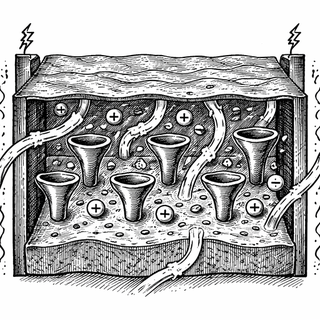
This is where the new research gets genuinely clever. The team introduced something called calix[4]pyrrole into a hydrogel system. If that name sounds intimidating, think of these molecules as tiny, cup-shaped bouncers at the entrance to a nightclub. They have a very specific guest list.
In this case, the "nightclub" is a thermogalvanic cell that uses the ferricyanide/ferrocyanide redox couple - a well-known electrochemical pair that researchers have used for years in thermoelectric systems. The problem has always been that both the oxidized and reduced forms of these iron-cyanide ions float around freely, canceling each other out and killing your voltage. It's like having fans from both teams rushing the same tunnel after a game - total gridlock.
The calix[4]pyrrole molecules act as selective anion traps. They preferentially grab and hold specific anion species, preventing them from drifting back and ruining the concentration gradient. By regulating two different anion species simultaneously - what the researchers call "synergistic dual anion regulation" - they created a dramatically stronger one-way flow of electrochemical activity.
The result? Giant thermopower and power density. Not "slightly improved." Not "marginally better." The kind of leap that makes materials scientists spill their coffee.
Why "Giant" Actually Means Something Here
In thermoelectric research, people throw around the word "enhanced" like confetti. A 10% improvement gets a press release. A 50% improvement gets a keynote. But the numbers in this study represent the kind of jump that changes the conversation about whether gel-based thermoelectric devices can actually be practical.
The hydrogel format is particularly exciting because gels are soft, flexible, and biocompatible. You can mold them. You can wear them. Unlike rigid semiconductor-based thermoelectric devices (which work fine for industrial heat recovery but are about as comfortable on skin as wearing a ceramic tile), hydrogels could actually be integrated into wearable medical devices, patches, and flexible electronics.
Think about it from a patient care perspective. A post-surgical patient needs continuous temperature monitoring. A diabetic patient needs glucose tracking. An elderly patient at home needs fall detection with cardiac monitoring. All of these currently depend on batteries that need charging or replacement - which is exactly the point where patient compliance falls apart. Nobody forgets to generate body heat.
The Bigger Picture
This research sits at the intersection of materials science, electrochemistry, and wearable health technology. The supramolecular chemistry approach - using specifically designed molecular containers to control ion behavior - opens a toolbox that goes beyond just this one application. If you can selectively trap and regulate specific ions in a gel, you can potentially tune these systems for different temperature ranges, different power requirements, and different form factors.
We're not at the "slap it on a patient" stage yet. This is still fundamental research, and there's a long road from lab-scale demonstration to FDA-cleared medical device. But the gap between "thermoelectric gels are an interesting curiosity" and "thermoelectric gels can generate meaningful power" just got a lot smaller.
As someone who spent years untangling IV lines and swapping out dead monitor batteries at 3 AM, I can tell you - anything that moves us toward self-powered medical wearables is worth paying attention to. Even if it involves molecules I can barely pronounce.
What Comes Next
The immediate challenge is scaling this technology and testing it under real-world conditions - meaning variable temperatures, humidity, movement, and all the chaos that actual human skin brings to the party. The long game is integration with flexible electronics and biosensors to create truly autonomous wearable health monitors.
For now, file this one under "quietly brilliant materials science that might change how we power the devices keeping people alive." Not bad for a fancy piece of jelly.
This blog post discusses research findings and should not be taken as medical advice. If you have concerns about wearable health monitoring or thermoelectric technology, please consult a healthcare provider. Research discussed here represents ongoing scientific investigation and clinical validation is still in progress.
All images used in this post are decorative illustrations only and do not represent or reflect the accuracy, reality, or correctness of the referenced research.
Primary Source: Synergistic dual anion regulation unlocks giant thermopower and power density in hydrogel. PubMed. 2026. PMID: 41912575