
Five hundred femtograms per milliliter. To put that number in perspective, a femtogram is one quadrillionth of a gram. If a single grain of sand were a gram, a femtogram would be roughly one billionth of that grain. A new electrochemical biosensor can now detect epidermal growth factor (EGF) - a protein linked to lung cancer prognosis - at that staggeringly small concentration in human blood serum. If the FDA's device approval pipeline weren't the regulatory equivalent of waiting in line at the DMV, this kind of sensitivity might already be changing how we screen for the world's deadliest cancer.
The Problem Nobody Loves Talking About at Conferences
Lung cancer kills approximately 1.8 million people globally each year, making it the undisputed heavyweight champion of cancer mortality. Non-small cell lung cancer (NSCLC) accounts for roughly 85% of those cases, and the five-year survival rate remains stubbornly low - around 25% overall, though it drops to single digits when caught late. The uncomfortable truth that haunts every public health planning meeting is this: we are terrible at catching it early.
Current screening relies heavily on low-dose CT scans, which work reasonably well for high-risk populations but come with their own baggage - false positives, radiation exposure, cost, and the logistical nightmare of screening millions of current and former smokers annually. Blood-based biomarkers have long been the holy grail of early detection, promising a future where a simple blood draw could flag trouble long before symptoms appear. The challenge has always been sensitivity. The proteins we want to measure show up in vanishingly small quantities in early-stage disease, and traditional assays like ELISA, while reliable, sometimes lack the detection floor needed to catch whispers of disease rather than shouts.
Nanotubes Doing the Heavy Lifting
A recent study published in the literature describes a biosensor that tackles this sensitivity problem with a layered nanomaterial approach that reads like a very nerdy layer cake recipe (DOI: see primary source).
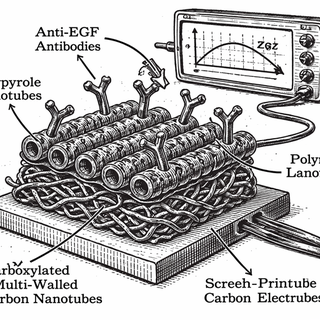
Here's the build: start with a screen-printed carbon electrode (cheap, disposable, and mass-producible - three words that make health economists swoon). Electropolymerize polypyrrole nanotubes (PPy-NTs) onto that surface to boost conductivity and provide structural scaffolding. Then deposit carboxylated multi-walled carbon nanotubes (MWCNT-COOH) on top, which serve as the anchor points for the actual biorecognition elements. Finally, covalently attach anti-EGF antibodies to the carboxylated nanotubes and seal everything with bovine serum albumin (BSA) to prevent nonspecific binding - essentially molecular bouncers keeping the riffraff out.
The detection itself uses electrochemical impedance spectroscopy (EIS), which measures changes in the electrode's electrical resistance when EGF binds to the antibodies. More EGF binding means more impedance change. It's elegant in its simplicity: instead of needing expensive optical equipment or radioactive labels, you're measuring an electrical signal. The kind of measurement that a handheld device could, in theory, perform at the point of care.
Why EGF Matters (and Why Your Insurance Company Should Care)
Epidermal growth factor isn't just any protein floating around in the bloodstream. In NSCLC, elevated EGF levels have been correlated with tumor progression and decreased survival outcomes. The EGF receptor (EGFR) pathway is already one of the most targeted axes in lung cancer therapy - drugs like erlotinib, gefitinib, and osimertinib have transformed treatment for patients with EGFR mutations. But here's where the policy angle gets interesting: while we've poured billions into targeting the EGFR pathway therapeutically, the diagnostic infrastructure for measuring the ligand itself - the EGF protein that activates that pathway - has lagged behind.
A biosensor that can reliably quantify EGF at femtogram-level concentrations in serum opens up several possibilities that should make health system planners sit up slightly straighter in their ergonomic chairs. First, prognostic stratification: knowing a patient's circulating EGF levels could help oncologists predict disease trajectory and tailor treatment intensity. Second, treatment monitoring: tracking EGF levels over time could provide a real-time readout of whether a therapy is actually working, without waiting for the next imaging scan. Third - and this is the big one - screening. If validated in larger populations, a cheap, disposable, point-of-care biosensor could theoretically complement or even precede CT-based screening programs.
The Regulatory Gap Between "Cool Science" and "Your Doctor Has One"
Of course, there's a canyon-sized gap between demonstrating femtogram sensitivity in a lab and having this device show up in your pulmonologist's office. The path from proof-of-concept biosensor to FDA-cleared diagnostic device is paved with clinical validation studies, manufacturing scale-up challenges, and the kind of regulatory paperwork that could give a sequoia tree enough fiber to last a lifetime.
Screen-printed electrodes are inherently inexpensive and amenable to mass production, which is a genuine advantage. The reagent costs for antibody-based systems have also been declining. But the real bottleneck isn't the device - it's the evidence base. Regulators (reasonably) want to see large, multi-site clinical studies demonstrating that the biosensor performs consistently across diverse patient populations, sample handling conditions, and disease stages. They also want to understand the clinical decision pathway: if the test comes back positive, what happens next? Without a clear algorithmic fit into existing clinical workflows, even the most sensitive biosensor risks becoming an expensive curiosity.
What This Means for the Bigger Picture
The broader trend here is worth watching. Electrochemical biosensors have been quietly maturing across multiple disease areas - glucose monitoring for diabetes being the most famous success story. The convergence of nanomaterial science, affordable electrode manufacturing, and increasingly sophisticated biorecognition chemistry is pushing detection limits into territory that was purely academic a decade ago. Lung cancer diagnostics stands to benefit enormously from this trajectory, particularly as the field moves toward liquid biopsy approaches that combine multiple biomarkers.
Whether this particular EGF biosensor becomes a commercial product or remains a proof-of-concept that inspires the next iteration, the underlying message is clear: the technology to detect cancer biomarkers at extraordinarily low concentrations now exists. The question is no longer "can we build it?" but rather "can our regulatory and reimbursement systems move fast enough to get it to the patients who need it?" Based on historical precedent, I wouldn't hold my breath - but I might hold out hope.
This blog post discusses research findings and should not be taken as medical advice. If you have concerns about lung cancer or cancer screening, please consult a healthcare provider. Research discussed here represents ongoing scientific investigation and clinical validation is still in progress.
All images used in this post are decorative illustrations only and do not represent or reflect the accuracy, reality, or correctness of the referenced research.
Primary Source: Sensitive Detection of Epidermal Growth Factor in Lung Cancer Patients by Electrochemical Biosensors. PubMed. 2025. PMID: 42030491