
It's 3 AM. You're exhausted. Your body is begging for sleep. But your brain? Your brain has decided this is the perfect time to run through every embarrassing thing you did in middle school while simultaneously refusing to let you close your eyes.
Now imagine that's your every night. For years.
If you have Parkinson's disease, there's an 80% chance you know exactly what I'm talking about. Insomnia isn't just a Parkinson's side effect - it's practically a membership requirement. And unlike "normal" insomnia that might respond to melatonin gummies or counting sheep, Parkinson's-related insomnia often laughs in the face of standard treatments.
But here's where it gets weird and wonderful: researchers at Mayo Clinic accidentally discovered that zapping a tiny, overlooked part of the brain might flip the switch back to "sleepy."
How Do You Accidentally Discover a Sleep Switch?
The story starts with rats. (The best neuroscience stories usually do.)
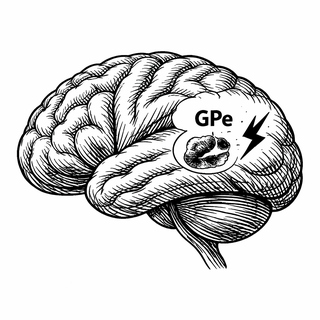
In 2016, researchers at Harvard were poking around in the brains of rats, stimulating different regions with electricity to see what would happen. When they hit the globus pallidus externa - a small structure buried deep in the brain that nobody had paid much attention to for sleep research - the rats basically said "goodnight" and fell asleep.
Not sedated sleep. Not drugged sleep. Actual, natural-looking sleep, with normal REM cycles and everything (Qiu et al., 2016).
The GPe, as it turns out, has a direct line to the brain's natural sleep-promoting center. Stimulating it was like pressing the "sleep" button on a remote control. The researchers were baffled. Nobody had thought to look there.
From Sleepy Rats to Sleepless Humans
The Mayo Clinic team thought: "What if this works in people?"
They had a patient with Parkinson's who couldn't sleep no matter what they tried - multiple medications, behavioral therapy, the whole arsenal. The patient was already scheduled for deep brain stimulation surgery to help with motor symptoms, so the surgeons added a second electrode targeting the GPe.
The results were published in Mayo Clinic Proceedings in 2020, and they were genuinely surprising. Not only did the patient's insomnia improve, but a tremor that hadn't responded to standard DBS suddenly got dramatically better too (Castillo et al., 2020).
Two-for-one deal. Not bad.
The Clinical Trial: Let's See If Lightning Strikes Twice
Now Mayo Clinic is running a formal trial NCT04116996 to see if this wasn't just a lucky break.
They're recruiting Parkinson's patients who are already scheduled for DBS surgery but also suffer from severe insomnia that hasn't responded to at least three different treatments. (So basically, people who've tried everything and are still staring at the ceiling at 4 AM.)
During surgery, patients get an extra electrode implanted in the GPe alongside their standard DBS electrodes. The researchers then measure changes in the Insomnia Severity Index - a validated questionnaire where higher scores mean worse sleep - along with polysomnography (the gold-standard sleep study with all the wires and electrodes).
The beauty of this approach is that it piggybacks on surgery patients were already getting. No extra brain surgery required - just an additional electrode while they're in there anyway.
Why GPe and Not the Usual Suspects?
If you know anything about Parkinson's DBS, you might be thinking: "Wait, don't they usually target the GPi or the subthalamic nucleus?"
You're right. Those are the standard targets for motor symptoms. But the GPe sits at a strategic junction in the brain's wiring, sending connections to both motor AND non-motor pathways.
Here's the cool part: the GPe might actually have a natural role in promoting sleep. When researchers damage the GPe in animal studies, the animals develop profound insomnia. Stimulate it, and they sleep better. It's like the GPe is a dimmer switch for consciousness that nobody realized was there.
The brain is weird, you guys.
Why Parkinson's Insomnia Is So Brutal
Quick detour to explain why Parkinson's patients can't just take Ambien and call it a day.
First, Parkinson's itself messes with the brain regions that control sleep. The same neurodegeneration that causes tremors and stiffness also disrupts the circuits that regulate sleep-wake cycles.
Second, the motor symptoms themselves are sleep-wreckers. Imagine trying to fall asleep when your body decides to periodically shake or freeze up.
Third, many Parkinson's medications can cause insomnia as a side effect. So you're taking drugs to help your movement that then keep you awake, which makes your movement worse, which makes you need more drugs... it's a fun spiral.
Fourth, sleeping pills carry extra risks for Parkinson's patients. They're already prone to falls and cognitive issues - adding sedatives to the mix is like giving a tightrope walker a few beers.
This is why finding a targeted, non-pharmacological approach is such a big deal.
What This Could Mean For Real People
Let's be clear: this is still early-stage research. One case study and an ongoing trial don't make a treatment standard. We need more patients, longer follow-up, and rigorous controlled studies.
But the potential is exciting. If GPe stimulation consistently helps with both motor symptoms AND insomnia, it could change how doctors approach DBS surgery for Parkinson's patients. Instead of just targeting movement, they could potentially address one of the most quality-of-life-destroying symptoms at the same time.
For the millions of Parkinson's patients who spend their nights exhausted but unable to sleep, that's not nothing. That's hope.
The Bottom Line
Somewhere in your brain, there's a tiny structure that might be the key to actually sleeping through the night. For decades, nobody thought to look there. Now, thanks to some curious researchers, some sleepy rats, and one very lucky Parkinson's patient, we might finally be onto something.
The Mayo Clinic trial is ongoing. Results are still pending. But sometimes the most important discoveries come from asking "what happens if we poke this?" in places nobody thought to poke.
Science is weird and wonderful. And occasionally, it lets people sleep.
References
-
Qiu MH, Chen MC, Wu J, Nelson D, Lu J. Deep brain stimulation in the globus pallidus externa promotes sleep. Neuroscience. 2016;322:115-120. DOI: 10.1016/j.neuroscience.2016.02.032
-
Castillo PR, Middlebrooks EH, Grewal SS, et al. Globus Pallidus Externus Deep Brain Stimulation Treats Insomnia in a Patient With Parkinson Disease. Mayo Clinic Proceedings. 2020;95(2):419-422. DOI: 10.1016/j.mayocp.2019.11.020
-
ClinicalTrials.gov. Globus Pallidus Stimulation to Treat Insomnia. Identifier: NCT04116996. https://clinicaltrials.gov/study/NCT04116996
This blog post is for educational purposes only and does not constitute medical advice. If you have Parkinson's disease and sleep problems, please talk to your neurologist or sleep specialist - they know your brain way better than a blog does.
Images and graphics are for illustrative purposes only and do not depict actual medical devices, procedures, mechanisms, or research findings from the referenced studies.