
Most people assume antibiotic resistance is only a hospital problem, or maybe a problem hiding inside bacteria themselves like tiny biochemical hooligans. But here's what actually happens... resistance can leave the cell, float around in wastewater, and keep telling the same bad story somewhere else. Free antibiotic resistance genes, or ARGs, are bits of genetic material in water that can signal how resistance is moving through the environment. And according to a fascinating new paper, researchers have built a miniature detection system using a DNA hydrogel inside a 3D-printed tube to track them directly. That sentence sounds like a science fair project designed by a very ambitious octopus, but it is real and surprisingly elegant.
Why wastewater is part of the antibiotic resistance conversation
Wastewater treatment plants sit in an awkward but vital position. They are supposed to clean up the biological and chemical messes we send their way, yet they also collect material from homes, hospitals, industry, and agriculture. If antibiotic resistance genes are moving through that stream, the plant becomes both a checkpoint and a test site.
That matters because researchers want to know two things. First, how much resistance-related genetic material is present during treatment? Second, how much is still present afterward, when treated water returns to the wider environment? If you can measure that well, you get a better sense of whether treatment is reducing risk or letting some of it slip through the net.
The tricky part is that these free ARGs are not always easy to catch. They can be present at low levels, mixed into messy real-world samples, and buried in biological noise. Wastewater is not exactly a tidy lab buffer. It is more like trying to find one sentence from a shredded memo inside a wet recycling bin.
So what did the researchers actually build?
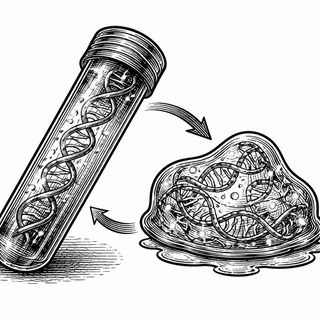
The core idea is wonderfully specific: pack a functional DNA hydrogel into a 3D-printed microextractor tube and use it as a fluorescence biosensor.
A DNA hydrogel is a soft material made from DNA strands arranged into a network. In this case, it is not just sitting there looking clever. It is designed to help extract and detect target ARGs from water environments and biological samples. The hydrogel used a fluorescent system based on a compound called 1,1,2,2-tetra(4-carboxylbenzene)ethylene, combined with DNA structures that respond to the presence of target genetic sequences.
Then comes the engineering twist. The hydrogel is packed into a 3D-printed tube, creating what the paper describes as a fluorescence biosensor-integrated microextractor. That spatial setup is not just convenient packaging. The tube provides a confinement effect, which helps the detection chemistry work more efficiently in a small, controlled space.
In other words, this is not simply "put glowing stuff in a tube and hope for the best." It is a compact extraction-and-sensing device designed to pull in target genes and amplify the signal when they are present.
The signal boost that makes this useful
The study also used a strand displacement amplification reaction. That phrase is admittedly a bit of a mouthful, but the concept is friendly enough: it is a molecular signal-boosting trick.
When the target ARG sequence is present, it triggers a chain of DNA interactions that amplify the readout. Instead of relying on a faint one-to-one signal, the system can generate a stronger fluorescent response. For environmental monitoring, that is a big deal. Detecting tiny amounts of target DNA in dirty samples is hard, and faint signals are how good ideas end up sulking in the corner.
The paper reports highly sensitive fluorescence detection of free ARGs, with low limits of detection. Even from the partial abstract, the message is clear: the researchers were aiming for direct tracking, rapid extraction, and high sensitivity in a realistic monitoring context.
That combination is what makes this interesting. Plenty of sensing methods look great in polished lab conditions. The real test is whether they can handle complicated samples without collapsing into methodological drama.
Why a DNA gel is such a clever choice
There is something almost poetic about using DNA to detect stray DNA. The hydrogel acts as both a structured material and a recognition platform. Because DNA strands can be designed to bind specific sequences, the material can be tuned toward particular ARG targets.
That gives the system selectivity, which is exactly what environmental surveillance needs. You do not want a sensor that lights up every time any random genetic fragment wanders by like an overenthusiastic smoke alarm reacting to toast.
The hydrogel format may also help with stability and handling. Instead of a purely liquid assay that requires careful setup each time, integrating the sensing chemistry into a material inside a printed device nudges the whole method toward something more portable and practical. Not quite pocket science, perhaps, but a step away from "requires a cathedral of lab equipment."
Why this matters outside the lab
If this kind of tool keeps developing, it could make wastewater surveillance faster and more direct. That has a few obvious upsides.
Researchers and plant operators could potentially monitor treatment performance more closely. Environmental scientists could track resistance-related risks in water systems with better sensitivity. Public health teams might gain another early-warning tool for changes in resistance burden outside clinical settings.
That last point is worth sitting with for a moment. Antibiotic resistance is often discussed after it becomes visible in patients, where the stakes are already high. Environmental tracking shifts some attention upstream. It asks whether we can spot risk patterns before they become somebody's medical emergency.
And there is also a broader lesson here: 3D printing and programmable biomaterials are starting to meet in very practical ways. We sometimes talk about futuristic biosensing as if it will arrive wearing chrome boots and making dramatic entrance music. More often, it arrives as a very smart tube full of engineered gel.
The limits and the next questions
As promising as this sounds, a single research paper is not the finish line. The obvious next questions are the ones any curious reader should ask.
How robust is the device across different wastewater settings and seasonal conditions? Can it distinguish among multiple important ARG targets in parallel? How easy is it to scale, standardize, and deploy outside specialized research teams? And how does it compare, in practice, with existing molecular detection methods on cost, speed, and reliability?
Those questions do not take away from the achievement. They are the reason the achievement matters. A good prototype should make you curious about what comes next.
For me, the fun of this paper is that it takes a sprawling public-health problem and attacks it with something surprisingly compact: a DNA hydrogel, a fluorescence readout, and a 3D-printed microextractor working together to fish meaningful signals out of very messy water. That is the sort of science that feels less like abstract theory and more like a tool beginning to earn its place in the world.
This blog post discusses research findings and should not be taken as medical advice. If you have concerns about antibiotic resistance, water safety, or related health risks, please consult a healthcare provider or appropriate public health authority. Research discussed here represents ongoing scientific investigation and clinical validation is still in progress.
All images used in this post are decorative illustrations only and do not represent or reflect the accuracy, reality, or correctness of the referenced research.
Primary Source: PubMed Record 42012074. DNA Hydrogel-Based Fluorescence Biosensor Packed in a Three-Dimensional-Printed Microextractor for Direct Tracking of Free Antibiotic Resistance Genes in Wastewater Treatment Plants. PubMed