
Shoes are passive. Midsoles just cushion impacts. Walking is something your muscles handle without help. Robots are rigid hunks of metal. And running electricity through your footwear sounds like a spectacularly bad idea.
Wrong on all five counts.
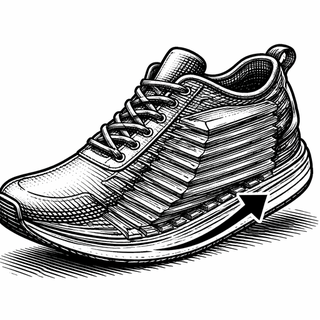
Researchers at the University of Nebraska at Omaha have built something called the Flash-Sole - an active midsole packed with soft, squishy actuators that use electrical signals to give your foot a gentle push right when you need it most. And they just registered a clinical trial (NCT07507006) to test it on actual human feet. I've been reading about this for the past two hours and honestly, I think this might be one of the coolest things happening in biomechanics right now.
Wait, Electricity in Your Shoes? On Purpose?
Okay, let me explain before your brain conjures images of cartoon electrocution. The Flash-Sole uses dielectric elastomer actuators (DEAs) - essentially layers of soft rubbery material sandwiched between flexible electrodes. When you apply a voltage, the electrostatic force squeezes the elastomer, causing it to expand. Stack a bunch of these layers together and you get a soft, lightweight actuator that can produce meaningful mechanical force without a single gear, motor, or rigid component.
The science behind DEAs has been building for over two decades. Back in 2000, Pelrine and colleagues published a landmark paper in Science demonstrating that these elastomers could achieve strains greater than 100% - basically, they could double in size when activated (DOI: 10.1126/science.287.5454.836). That paper blew the doors open for soft robotics, and researchers have been finding creative applications ever since.
The Flash-Sole team took this concept and asked a beautifully simple question: what if we put stacked DEAs inside a shoe and timed them to fire during push-off?
Why Push-Off Matters More Than You Think
Here's a quick biomechanics lesson that will change how you think about walking. When your foot leaves the ground - that moment where your toes push off the surface - your ankle plantarflexor muscles are doing a huge amount of work. The push-off phase generates the majority of the forward propulsive force during normal gait. For young, healthy people, this is no big deal. But as we age, or when neurological conditions enter the picture, push-off power drops, stride length shortens, and walking becomes exhausting.
This is exactly why the assistive exoskeleton field has exploded in recent years. Collins et al. demonstrated in 2015 that even a completely unpowered ankle exoskeleton - using only a clever spring mechanism - could reduce the metabolic cost of walking by about 7% (DOI: 10.1038/nature14288). Zhang and colleagues pushed things further in 2017 with powered systems optimized through human-in-the-loop algorithms, achieving metabolic reductions of nearly 25% (DOI: 10.1126/science.aal5054).
But here's the catch with most of these devices: they're bulky, rigid exoskeletons strapped to your leg. They work great in a lab. Walking to the grocery store in one? Not so much.
So What Makes Flash-Sole Different?
This is the part where I start gesturing excitedly. The Flash-Sole lives inside your shoe. No exoskeleton frame. No rigid joints. No actuator pack strapped to your calf. Just a midsole that happens to be quietly doing some of the work for you.
The "stacked" part of "stacked dielectric elastomer actuators" is key. A single DEA layer doesn't produce enough force to meaningfully assist walking. But stack dozens of thin layers - like a very ambitious mille-feuille made of science - and you can generate forces worth talking about. The entire system uses soft materials that flex and compress naturally with each step, making it fundamentally different from the rigid motors and pneumatic systems that dominate current assistive technology.
Soft actuators for wearable robotics have been gaining serious traction in the research community. Recent reviews on intrinsically soft wearable devices highlight DEAs as one of the most promising technologies for this exact application - lightweight, compliant, silent, and capable of high energy density output. The Flash-Sole represents one of the first attempts to bring stacked DEA technology into a form factor that a regular person could actually wear without looking like they're auditioning for a sci-fi movie.
The Trial: First Steps (Literally)
The clinical trial is a feasibility study - think of it as the "does this thing actually work on real humans and not just on a test bench" phase. Up to 15 healthy adults between ages 19 and 45 will visit the Biomechanics Research Building at UNO for a single two-hour session.
Participants will walk on a treadmill at comfortable speeds wearing shoes equipped with the Flash-Sole, with the device toggled on and off so researchers can compare assisted vs. unassisted walking. Sticky sensors on participants' legs will capture motion data and muscle activity, while a safety harness keeps everyone upright (always reassuring). Afterward, participants fill out surveys about comfort and usability.
The researchers are refreshingly honest about scope here. This isn't testing whether Flash-Sole helps people with mobility impairments - not yet. They want to know three things: Is it safe? Is it comfortable? Does it actually do what it's supposed to do? You have to walk before you can run, and apparently, you have to test a walking device before you can test a walking device. Beautiful recursion.
The Bigger Picture
If Flash-Sole works - and that's still an "if" at this early stage - the implications are genuinely exciting. Imagine a world where people recovering from strokes, living with cerebral palsy, or simply dealing with age-related gait decline could slip on a pair of shoes that quietly compensate for lost ankle power. No harnesses, no visible hardware, no stigma. Just shoes that happen to be helpful.
The broader trend is clear: assistive technology is shrinking, softening, and disappearing into everyday objects. We went from room-sized computers to pocket smartphones. The same trajectory is happening with wearable robotics, and Flash-Sole is a glimpse of where it's heading.
I'll be watching this trial closely. Because honestly? The idea that a squishy, electric shoe insert could meaningfully help people walk - that's the kind of science that makes you want to stand up and take a few steps in appreciation.
Preferably while wearing electric shoes.
This blog post is for informational and educational purposes only. It does not constitute medical advice. The Flash-Sole device is investigational and has not been approved by the U.S. Food and Drug Administration (FDA). For full trial details, visit ClinicalTrials.gov - NCT07507006.
References:
-
Pelrine, R., Kornbluh, R., Pei, Q., & Joseph, J. (2000). High-speed electrically actuated elastomers with strain greater than 100%. Science, 287(5454), 836-839. DOI: 10.1126/science.287.5454.836
-
Collins, S. H., Wiggin, M. B., & Sawicki, G. S. (2015). Reducing the energy cost of human walking using an unpowered exoskeleton. Nature, 522(7555), 212-215. DOI: 10.1038/nature14288
-
Zhang, J., Fiers, P., Witte, K. A., et al. (2017). Human-in-the-loop optimization of exoskeleton assistance during walking. Science, 356(6344), 1280-1284. DOI: 10.1126/science.aal5054