
What is light enough to be built with gentle chemistry, roomy enough to host molecules, sociable enough to assemble itself with hydrogen bonds, and yet stubborn enough to disappoint you the moment you ask it to do real work? The answer, in this case, is the hydrogen-bonded organic framework, or HOF. For years, materials scientists have looked at these elegant porous structures the way one looks at a charming old convertible. Lovely lines, plenty of admiration, and just enough mechanical unreliability to make one nervous about a long trip.
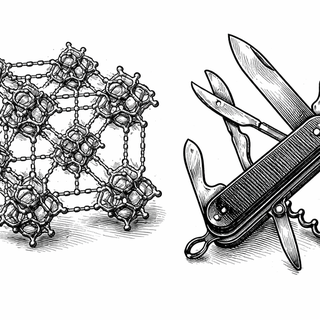
That is why this new review on nano-structuring hydrogen-bonded organic frameworks is so interesting. It tackles the central problem with HOFs in their bulk form: they are promising, but often not sturdy or conductive enough for demanding applications. The review argues that when these materials are reshaped into nanostructures or blended into nanocomposites, they begin to show rather better manners. In other words, the same material that seems a touch delicate at full scale can become unexpectedly capable when trimmed down and partnered wisely.
What HOFs Are, Minus the Jargon Fog
A hydrogen-bonded organic framework is a porous material built from organic molecules held together mainly by hydrogen bonds. These are the same sorts of interactions that help water behave like water and help DNA keep its famous helical dignity. Hydrogen bonds are not as strong as the bonds that hold the backbone of a molecule together, but they are wonderfully useful for self-assembly. Give the right molecules the right circumstances and they can snap into tidy, repeating architectures with pores and channels.
Researchers like HOFs for several reasons. They can offer high surface area, which is a polite way of saying there is a great deal of useful internal real estate packed into a small amount of material. They can often be made under mild conditions, which saves effort and expands what can be incorporated during synthesis. They can also be solution-processable, which means they are not always as difficult to handle as some of their more temperamental cousins in the porous-material family. The review also highlights biocompatibility as a major attraction, especially for biomedical directions.
That sounds splendid, and indeed it is. But old professors learn to squint at the fine print.
Why Bulk HOFs Have Been Frustrating
The trouble is that bulk HOFs can suffer from weak structural stability and poor electrical conductivity. Those are not decorative problems. If a material is meant to catalyze reactions, store energy, move charge, or survive in complicated real-world environments, it must do more than look organized under a microscope.
Poor conductivity limits its usefulness in electrochemical and energy-related settings. Structural fragility raises concerns about whether the framework will remain intact during operation, processing, or exposure to solvents and temperature changes. One can have the prettiest pores in the county, but if the framework slumps at the first sign of practical use, industry will not exactly form a parade.
This review focuses on a sensible remedy: make HOFs small, make them composite, or both.
Why Going Nano Changes the Story
Nanostructuring is not just scientific fashion, though fashion does drift through laboratories from time to time. When HOFs are turned into nanomaterials, their size, interface behavior, and confinement effects can change how they perform. At the nanoscale, transport can improve, active sites can become more accessible, and the material can interact more effectively with its surroundings.
Even more interesting is the composite strategy. Pair a HOF with another material, perhaps one that contributes conductivity, mechanical support, or stability, and you can create a system in which each component compensates for the other’s deficiencies. It is the academic version of a good marriage. One partner remembers the anniversaries, the other knows how to restart the router.
According to the review, these nanostructured HOFs and HOF-based nanocomposites can show enhanced conductivity, stability, and porosity. That combination matters because it turns a material once admired mostly for its conceptual elegance into something more practical and versatile.
Where These Materials Might Matter
The applications discussed in the review span a surprisingly broad range.
Photocatalysis is one of the most appealing. If a material can absorb light and help drive useful chemical reactions, it becomes relevant to environmental cleanup, solar-to-chemical conversion, and other tidy ambitions that chemists have cherished for decades. The porous nature of HOFs can help gather reactants, while nanoscale engineering may improve charge movement and reaction efficiency.
Energy storage is another obvious frontier. Batteries and supercapacitors are unforgiving teachers. They expose every weakness in conductivity, ion transport, and structural endurance. A nano-engineered HOF composite that can store charge more effectively or cycle more reliably would be a meaningful advance, not just a handsome diagram in a review article.
Then there is photothermal therapy, which brings the story closer to biomedicine. In that setting, materials are designed to absorb light and convert it into heat in a controlled way, potentially helping treat diseased tissue. Here the mild synthesis and biocompatibility associated with HOFs become especially attractive. A material that can be prepared gently, tuned structurally, and integrated into a biomedical platform is bound to draw attention.
That said, attention is not the same as adoption. I have lived long enough to see many dazzling materials arrive in the literature wearing trumpets and leave by the side door wearing silence. The path from promising platform to dependable technology is never short.
Why This Review Matters Now
What makes this paper worth reading is not merely that it praises HOFs. Plenty of papers do that with the breathless optimism of a grant proposal in mating season. The real value here is that it frames the field around classification, fabrication strategies, and applications, while keeping the central engineering challenge in view. HOFs are not being presented as magical substances that solve everything. They are being treated as materials that need careful redesign to fulfill their promise.
That is a mature sign in a research area. Fields grow up when they stop asking, “Is this material interesting?” and start asking, “Under what structural conditions does this material become useful?” Nano-structuring is part of that grown-up conversation.
The broader lesson is one I have seen repeated across chemistry and materials science. Sometimes the key advance is not inventing an entirely new substance. Sometimes it is learning how to reshape, confine, stabilize, or hybridize an existing one until its better nature finally appears.
The Practical Hurdles Ahead
Several challenges remain obvious, even from a high-level review. Scalable fabrication will matter. Reproducibility will matter. Long-term stability in realistic operating environments will matter. And for biomedical uses, safety, biodistribution, and reliable performance in complex biological systems will matter a great deal.
There is also the perennial issue of translating laboratory cleverness into manufacturing discipline. It is one thing to produce an elegant nanocomposite on a careful day with pristine reagents and a patient graduate student. It is another thing entirely to make it robustly, repeatedly, and affordably. Science often wins the first argument; engineering must win the second.
Still, I would not dismiss this field for its difficulties. The appeal of HOF nanomaterials lies precisely in their combination of tunability, porosity, mild preparation, and functional adaptability. If researchers can keep improving stability and performance without sacrificing those advantages, these materials may find real homes in catalysis, energy devices, and biomedical technologies.
That is a fine prospect. Not flashy in the vulgar sense, but durable, useful, and intellectually satisfying. At my age, I find that preferable. Fireworks are lovely, but a well-built bridge is more dependable.
This blog post discusses research findings and should not be taken as medical advice. If you have concerns about conditions that may one day be addressed by nanomaterials or photothermal therapies, please consult a healthcare provider. Research discussed here represents ongoing scientific investigation and clinical validation is still in progress.
All images used in this post are decorative illustrations only and do not represent or reflect the accuracy, reality, or correctness of the referenced research.
Primary Source: Nano-structuring hydrogen-bonded organic frameworks: strategies, composites, and functional applications. PubMed record 42023481. Available at: https://pubmed.ncbi.nlm.nih.gov/42023481/