
Down at the level of skin and follicles, the scalp is never really sitting still. Tiny hair factories cycle through growth, rest, and shedding while hormones, blood flow, and cellular signals all bicker like overcaffeinated lab mates about what should happen next. In androgenetic alopecia, those signals gradually push follicles to shrink, miniaturize, and produce thinner, shorter hairs until the whole operation starts looking less like a thriving forest and more like a lawn mower lost interest halfway through. So when I read about a wearable device that delivers electrical stimulation to the scalp and actually outperformed a sham device in a randomized, double-blind trial, I had to put the paper down for a second and stare at the wall.
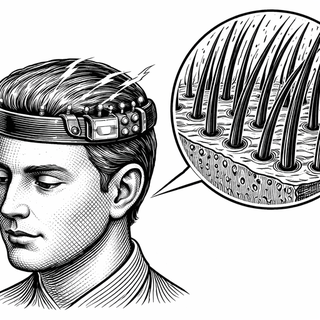
Why this study grabbed me immediately
Male pattern hair loss is astonishingly common, and it is not exactly a one-and-done problem. It usually needs long-term treatment, steady adherence, and patience bordering on saintly. That is part of why this new study is interesting. The researchers were not testing a miracle serum with a suspiciously dramatic before-and-after photo. They evaluated a wearable electrotrichogenic device called niostem in a proper clinical trial design: randomized, double-blind, sham-controlled.
That phrase is catnip to anyone who likes good evidence.
The trial enrolled 81 men between ages 18 and 55 with androgenetic alopecia ranging from Norwood-Hamilton stage II to VI. Participants were assigned either the active device or a sham version in a 5:3 ratio, then used it for 30 minutes a day over 24 weeks. Outcomes were measured at baseline, month 3, and month 6 using standardized photography and trichoscopy, which is a scalp imaging method that lets researchers count and assess hairs in a more rigorous way than squinting hopefully in bathroom lighting.
What the device actually did
The big result was that men using the active electrotrichogenic device had a significantly greater improvement in total hair density by month 6 than men using the sham device. The reported mean between-group difference was 24.40 hairs/cm².
That is the kind of number that makes you lean forward a little.
And wait, it gets better. The benefits were not limited to total hair density. The active device also improved terminal hair density and cumulative hair thickness compared with sham treatment. That matters because terminal hairs are the thicker, more visible hairs people actually care about when they look in the mirror. Nobody is celebrating an invisible bureaucratic increase in tiny wispy hairs. People want sturdier strands, and this study suggests the device may be helping in that direction too.
The authors also reported the device was safe and tolerable, which is not a glamorous finding, but it is a very necessary one. For a treatment meant to be used daily and potentially over long periods, tolerability is not a side note. It is the whole game. A therapy can be scientifically elegant and still fail in the real world if it is irritating, inconvenient, or just annoying enough to end up in a drawer next to abandoned resistance bands.
Why electrical stimulation for hair is such a fascinating idea
Hair loss treatments usually make people think of drugs, topical solutions, or procedures. A wearable scalp device feels like a different lane entirely. The term "electrotrichogenic" refers to using electrical stimulation in a way intended to support hair growth. The paper summary does not unpack every mechanistic detail, but the broad concept is that electrical signals may influence the follicular environment and the biology that governs growth.
That is what makes this feel so intriguing. Hair follicles are not passive tubes. They are metabolically active mini-organs with stem-cell behavior, signaling pathways, and a bizarrely dramatic life cycle. If a wearable device can nudge that system in a helpful direction without medication-level systemic exposure, that opens up a genuinely interesting treatment category.
I love this partly because it sounds futuristic, but not in the fake "smart toothbrush for your mitochondria" way. It sounds futuristic in the much more respectable sense of "someone actually ran the trial."
The part that keeps me from overhyping it
This is where the adult supervision kicks in.
The trial was single-center, and the main efficacy analysis was performed in a prespecified per-protocol population, meaning participants had to meet at least 70 percent compliance. That is reasonable for understanding whether the treatment works when people use it as directed, but it also means we still need to know how robust the effect looks across broader, more real-world patterns of use.
Also, the visible benefits were apparent at month 6, not overnight. Which, honestly, makes the findings more believable. Biology loves taking its sweet time. Hair especially behaves like it has read none of your deadlines.
Another detail worth noting is that the ClinicalTrials.gov registration was retrospective. That does not automatically sink the study, but it is the kind of methodological detail researchers and careful readers should keep in view. Good results deserve good scrutiny.
Why this could matter in real life
If follow-up studies confirm these results, a wearable non-drug option for androgenetic alopecia could be a big deal. Not everyone wants to use medication. Not everyone tolerates standard options well. And not everyone is excited about procedures. A device-based approach that is portable, noninvasive, and used for 30 minutes a day could fit a very real need.
That does not mean this is ready to be crowned the new king of hair restoration. It means the category just got a lot more interesting.
The most exciting scenario here is not "one gadget solves hair loss forever." Science is rude to that kind of optimism. The more realistic and still very compelling possibility is that wearable scalp stimulation becomes another legitimate tool, either on its own or alongside existing therapies. In a field where long-term adherence is everything, having more options matters.
My main takeaway
What stuck with me most is how refreshingly concrete this study is. This was not vague wellness language wrapped around scalp vibes. It was a randomized, double-blind, sham-controlled trial testing a specific wearable device over 24 weeks and finding statistically significant improvements in hair-related outcomes.
That is not proof that every electrical hair gadget is suddenly credible. Absolutely not. The internet remains the internet. But it is evidence that this particular approach deserves serious attention and replication. And for a research area that can attract both genuine science and eyebrow-raising marketing, that distinction is doing a lot of work.
So yes, I am impressed. Cautiously, academically, and with the full understanding that replication is the rent every exciting finding has to pay. But still impressed.
Because a wearable head device helping men grow denser hair in a blinded sham-controlled trial? That is not background noise. That is the kind of result that makes you sit up a little straighter and say, very scientifically, "wait, hold on."
This blog post discusses research findings and should not be taken as medical advice. If you have concerns about androgenetic alopecia or hair loss, please consult a healthcare provider. Research discussed here represents ongoing scientific investigation and clinical validation is still in progress.
All images used in this post are decorative illustrations only and do not represent or reflect the accuracy, reality, or correctness of the referenced research.
Primary Source: Efficacy, Safety, and Tolerability of a Wearable Electrotrichogenic Device in Men with Androgenetic Alopecia: A Randomized, Double-Blind, Sham-Controlled Trial. PubMed Record 42018094. PubMed: 42018094