
Your gut has a secret, and scientists just figured it out. Lurking inside an innocent-looking plate of mussels or scallops could be okadaic acid (OA) - a toxin produced by tiny ocean organisms called dinoflagellates that accumulates in shellfish and causes what's politely called "diarrhetic shellfish poisoning" and what your body calls "absolute betrayal." The problem? Detecting this toxin at dangerously low concentrations has been like trying to find a single Waldo in a stadium full of people wearing red-and-white stripes. Until now.
A team of researchers just built what can only be described as the Avengers of biosensors - a device that combines nano-sandwiched materials, tiny Trojan horse capsules, and light-powered transistors to detect okadaic acid at concentrations so vanishingly small (0.12 picomolar, for the number lovers) that it makes previous methods look like they were squinting through a foggy window.
What Even Is an OPECT? (And Why Should You Care?)
Let's start with the star of the show: the organic photoelectrochemical transistor, or OPECT. Think of a transistor like a tiny gatekeeper - it controls the flow of electrical current based on a signal it receives. Now imagine that gatekeeper also responds to light. That's your photoelectrochemical transistor. It sits at the intersection of optics, electronics, and biology like some sort of interdisciplinary overachiever who triple-majored in college.
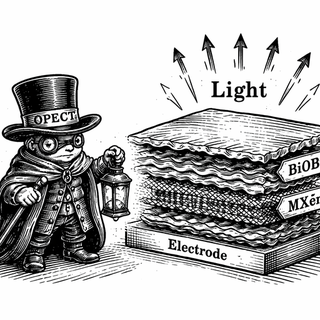
Most OPECTs operate in what's called "depletion mode" - they start in the ON state and you turn them off with a signal. It's like how most people are awake by default and need a boring lecture to fall asleep. But this research flipped the script. By doping a conductive polymer called PEDOT:PSS with small-molecule amines, the team switched the device to "accumulation mode" - starting OFF and turning ON when it detects something. If depletion mode is The Matrix where Neo starts inside the simulation, accumulation mode is like Neo waking up in the real world. Same person, totally different starting point, and arguably way more useful for sensing applications.
The Nano-Sandwich That Powers It All
The sensor's photosensitive gate material is MXene@BiOBr, or as I like to call it, the ultimate nano-sandwich. MXene is a family of two-dimensional materials - think graphene's cooler, more versatile cousin - that are incredibly conductive. BiOBr (bismuth oxybromide) is a semiconductor with excellent light-harvesting properties. Slap BiOBr onto MXene sheets and you get a composite material that generates a strong photocurrent when light hits it. It's like pairing Tony Stark's engineering with Thor's raw power - each component is impressive alone, but together they're practically unstoppable.
When dopamine molecules interact with MXene@BiOBr under illumination, the photocurrent response gets a significant boost. And that's where the detection magic starts.
Liposomes: The Trojan Horses of Biochemistry
Here's where the plan gets really clever - borderline Ocean's Eleven levels of clever.
Liposomes are tiny spherical vesicles made of lipid bilayers (basically, microscopic fat bubbles). Scientists loaded these liposomes with dopamine and tagged them with OA-BSA conjugates on their surfaces, creating what the paper calls OA-BSA-DLL conjugates. These are essentially molecular Trojan horses - they look like okadaic acid from the outside but carry a belly full of dopamine waiting to be released.
The detection works through a competitive immunoassay. Picture it like musical chairs: actual okadaic acid from a contaminated sample competes with the dopamine-loaded liposomes for binding spots on antibodies. When more real OA is present, fewer liposomes get captured, leaving more of them free in solution. After a lysis step (fancy word for "popping the liposomes open like molecular bubble wrap"), the released dopamine flows to the MXene@BiOBr electrode, boosting the photocurrent and cranking up the transistor signal.
More toxin in the sample means more free liposomes, means more dopamine released, means a bigger signal. It's an amplification cascade that would make a Rube Goldberg machine jealous - except this one actually works reliably at the picomolar level.
Why 0.12 Picomolar Is a Really Big Deal
Let's put that detection limit in perspective. A picomolar concentration means roughly 600 billion molecules per liter. That sounds like a lot until you realize that a liter of seawater contains about 3.3 x 10^25 water molecules. Finding OA at 0.12 picomolar is like finding a specific 72 people on a planet with a population of... well, a lot more than Earth's.
Current regulatory limits for okadaic acid in shellfish are set at parts-per-billion levels. This sensor operates orders of magnitude below that threshold, which means it could catch contamination long before it becomes dangerous - like having a smoke detector that alerts you when someone thinks about lighting a match.
The Bigger Picture: A Platform, Not Just a Sensor
What makes this research particularly exciting isn't just that it detects one toxin really well. The team essentially built a universal platform for accumulation-mode OPECT biosensing. Swap out the antibodies on the liposomes and you could theoretically detect different targets - other toxins, disease biomarkers, environmental contaminants. It's a modular system, like LEGO for biosensors.
The liposome amplification strategy is the real star here. By packaging signal molecules inside these tiny capsules and releasing them on demand, the researchers solved one of the persistent challenges in biosensor design: getting a big enough signal from a tiny amount of target. It's essentially a biochemical megaphone.
The shift to accumulation mode also matters. Starting from an OFF baseline means lower background noise, cleaner signals, and more reliable detection at extremely low concentrations. For the biosensor community, this is like upgrading from a walkie-talkie to noise-canceling headphones.
What's Next?
This is still lab-stage research, and there's a long road between a proof-of-concept biosensor and something you'd see at a seafood processing plant or a beach testing station. Challenges like long-term stability, manufacturing scalability, and real-world sample complexity still need addressing. But as a technological foundation? It's rock solid.
The combination of 2D nanomaterials, liposome-based signal amplification, and accumulation-mode organic transistors opens doors that weren't even visible a few years ago. Food safety testing, environmental monitoring, point-of-care diagnostics - the applications stretch as far as the imagination. And for those of us who love a good seafood dinner but would prefer not to spend the next 48 hours regretting it, that's pretty great news.
This blog post discusses research findings and should not be taken as medical advice. If you have concerns about shellfish safety or food-borne toxins, please consult a healthcare provider or local food safety authority. Research discussed here represents ongoing scientific investigation and clinical validation is still in progress.
All images used in this post are decorative illustrations only and do not represent or reflect the accuracy, reality, or correctness of the referenced research.
Primary Source: MXene@BiOBr-Mediated Liposome Amplification for Accumulation-Mode Organic Photoelectrochemical Transistor Immunoassay With In Situ Signal Amplification. PubMed: 42035442