
Here's a fun thought experiment: try opening a jar of pickles using only your shoulder. Go ahead, I'll wait. Difficult, right? Now imagine doing that every single day for the rest of your life because that's how your prosthetic arm works. Welcome to the world of body-powered prosthetics, where the human shoulder has been moonlighting as a sophisticated control system since the 1800s.
A new clinical trial (NCT07254247) is investigating an enhanced body-powered terminal device that could give upper-limb amputees something they've been wanting for decades - a prosthetic hand that can both voluntarily open AND voluntarily close with equal ease. If that sounds like it should already exist, well, buckle up, because prosthetic design is about to get fascinating.
The Old-School Charm of Body-Powered Prosthetics
Before we get into the fancy new stuff, let's talk about why anyone would use a "body-powered" prosthesis in 2025 when we have bionic arms that look like they belong in a Marvel movie.
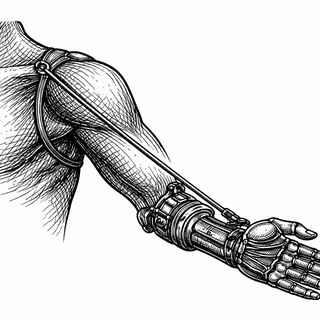
Body-powered prosthetics are the pickup trucks of the prosthetic world. They're rugged, reliable, don't need charging, and work just fine when you accidentally drop them in a puddle. They use a harness and cable system that connects shoulder movements to the prosthetic hand - kind of like those old cable-operated bicycle brakes, except the stakes are considerably higher than arriving at the bottom of a hill too fast.
According to research published in various prosthetics journals, many amputees actually prefer body-powered devices for work environments - especially outdoor jobs where getting sawdust or mud in a $100,000 myoelectric arm would be financially devastating (Carey et al., Journal of Prosthetics and Orthotics, 2015).
The Great Debate: Opening vs. Closing
Here's where things get weird. Most body-powered prosthetics can only do one thing actively - either open or close - but not both. It's like having a door that you can either push OR pull, but never both.
Voluntary Opening (VO) devices are closed at rest. You pull the cable to open them, and when you release, they snap shut like a tiny, helpful alligator. The grip force depends on rubber bands or springs - more bands equals tighter grip. These are great for holding onto things without thinking about it, but picking up anything delicate is like trying to give a handshake to a butterfly.
Voluntary Closing (VC) devices are open at rest. You pull the cable to close them, which gives you better control over grip force - fantastic for not crushing your coffee cup, but your arm gets tired if you need to hold something for more than a few minutes. Try making a fist for two minutes straight. Now imagine that's your entire day.
As Smit et al. noted in their research on prosthetic design, "Both voluntary opening (VO) and voluntary closing (VC) modes of operation have advantages for certain tasks, and many end-users desire a terminal device that can switch between the two modes" (DOI: 10.1097/JPO.0000000000000039).
The problem? Most designs that tried to combine both modes required you to readjust your entire harness every time you switched. Imagine having to retie your shoes every time you wanted to walk instead of run.
Enter the New Kid on the Block
The clinical trial at hand is evaluating a novel terminal device that promises enhanced grasping capabilities - presumably one that can switch between VO and VC modes without making you perform origami with your harness.
The key innovation in modern switchable designs is maintaining the same thumb position and cable attachment point in both modes. This means you can switch modes mid-task without your prosthetist getting a panicked phone call. Research from ToughWare's Equilux terminal device has shown that such designs are possible and practical - offering user-selectable voluntary opening and voluntary closing grasp capabilities.
Why This Actually Matters
Okay, so prosthetic hands can open and close in new ways. Big deal, right?
Actually, yes - massive deal. Consider this: upper-limb amputation affects over 2 million people in the United States alone, and the rejection rate for prosthetics is somewhere between 20-50% depending on the study. That's potentially a million people who tried a prosthetic arm and said, "You know what? I'd rather just not."
One of the major reasons for rejection is that prosthetics simply don't do what users need them to do. When your prosthetic hand is great at holding a hammer but terrible at holding an egg, you start making choices about what activities you're willing to attempt.
A terminal device with enhanced, switchable grasping could mean the difference between someone using their prosthesis all day or leaving it in a closet.
The Science of Shoulder-to-Hand Communication
For the curious nerds among us (my people), here's how body-powered prosthetics actually work:
- A harness wraps around your shoulders and chest
- A Bowden cable (yes, like bike brakes) connects to the terminal device
- Moving your shoulder creates cable tension
- Cable tension opens or closes the hand
The beautiful thing about this system is that it provides proprioceptive feedback - your brain can actually sense how open or closed the hand is based on shoulder position and cable tension. It's like how you know where your hand is even with your eyes closed, except now your shoulder is doing double duty as a position sensor.
This is something that even the fanciest myoelectric arms struggle to replicate. You can feel the resistance when you grip something, which is incredibly useful for not crushing objects or knowing when something is about to slip.
What the Trial Is Testing
While specific details vary, clinical trials for prosthetic devices typically measure:
- Grip force control: Can users generate appropriate force for different objects?
- Task completion: How quickly and successfully can users complete everyday activities?
- User satisfaction: Does the device actually make life better?
- Durability: Will this thing survive actual use?
The trial is likely recruiting upper-limb amputees to test the new device against existing options, measuring both objective performance metrics and subjective experiences.
The Bottom Line
The humble body-powered prosthetic has been around for over 150 years, and it's still the workhorse of the prosthetics world. But that doesn't mean it's perfect. A terminal device that combines the best features of VO and VC operation could represent a significant quality-of-life improvement for hundreds of thousands of users.
Sometimes the most impactful innovations aren't the flashiest ones. Sometimes it's just making a really good hook that can switch modes without requiring a physics degree to operate.
The clinical trial (NCT07254247) represents one more step toward a future where losing a limb, while never easy, doesn't mean losing the ability to live a full, capable life. And that's something worth getting a grip on.
References:
- Carey, S.L., et al. (2015). "Differences in Myoelectric and Body-Powered Upper-Limb Prostheses." Journal of Prosthetics and Orthotics, 27(4), 153-160.
- Smit, G., et al. (2015). "Design and evaluation of voluntary opening and voluntary closing prosthetic terminal device." Journal of Rehabilitation Research & Development, 52(2), 215-226. DOI: 10.1682/JRRD.2014.03.0087
- ToughWare PRX. Equilux VO/VC Terminal Device specifications and documentation.
Disclaimer: This blog post is for informational purposes only and does not constitute medical advice. Clinical trials are ongoing research and results are not yet confirmed. Always consult with qualified healthcare professionals regarding prosthetic options. The author is not affiliated with this clinical trial or its sponsors. Images and graphics are for illustrative purposes only and do not depict actual medical devices, procedures, mechanisms, or research findings from the referenced studies.