
Picture this: it's 3:17 AM, you're staring at your ceiling like it owes you money, and your brain has decided that right now is the perfect time to replay every awkward thing you've said since middle school. You flip the pillow. You try counting sheep. The sheep start judging you. Welcome to chronic insomnia - the villain origin story nobody asked for.
Now imagine if someone handed you a headband and said, "Put this on, it vibrates at special frequencies, and it might fix your sleep." You'd probably raise an eyebrow like The Rock (no relation to good sleep habits) and ask, "Seriously?" Well, a new clinical trial is asking exactly that question, and honestly? The science behind it is more fascinating than you'd expect.
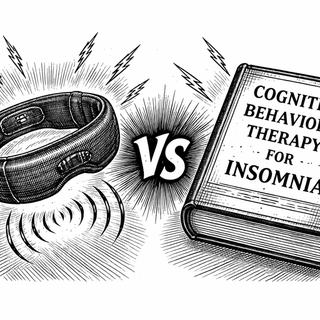
The Trial: Headband vs. Therapy, Fight!
A feasibility pilot study (NCT07486882) is now comparing two very different approaches to treating moderate-to-severe chronic insomnia disorder. In one corner, we have the reigning champion: Cognitive Behavioral Therapy for Insomnia, or CBT-I. In the other corner, the scrappy newcomer: Acoustic Resonance Therapy (ART), delivered through the SONU Headband.
Participants are randomized into one of two arms and followed for six weeks. The primary question is straightforward: which approach produces better changes in sleep quality? Think of it as the sleep research equivalent of The Great British Bake Off, except instead of pastries, the contestants are producing REM cycles. (Full trial details)
Wait, What Even Is CBT-I?
If you haven't heard of CBT-I, it's basically the Gandalf of insomnia treatments. It's been around, it's wise, and the evidence behind it is so strong that both the American College of Physicians and the European Sleep Research Society recommend it as the first-line treatment for chronic insomnia - before medications (Qaseem et al., 2016; Riemann et al., 2017).
CBT-I isn't just "think happy thoughts and go to sleep." It's a structured, multi-component program that typically runs four to eight weeks and includes sleep restriction (yes, they temporarily reduce your time in bed, which sounds cruel but works), stimulus control (your bed is for sleep, not doomscrolling), cognitive restructuring (teaching your brain to stop catastrophizing about sleep), and relaxation techniques.
A landmark meta-analysis of 20 randomized controlled trials found that CBT-I significantly improves sleep onset latency, wake time after sleep onset, and sleep efficiency, with effects that persist long after treatment ends (Trauer et al., 2015). It's the real deal. The LeBron James of sleep medicine. The problem? Access. There simply aren't enough trained CBT-I therapists to go around, waitlists can stretch for months, and let's be honest - not everyone is thrilled about committing to weeks of structured therapy when they can barely keep their eyes open during the day.
Enter the Headband: Acoustic Resonance Therapy
This is where things get Tron-level cool. Acoustic Resonance Therapy works on the principle that specific sound frequencies and vibrations can influence brain activity and promote the neural states associated with sleep. The SONU Headband delivers these acoustic signals directly, targeting the kind of slow-wave oscillations that your brain naturally produces during deep sleep.
The concept isn't as far-fetched as it sounds (pun absolutely intended). Research into auditory stimulation for sleep enhancement has been building momentum. Studies on binaural beats - where slightly different frequencies are played in each ear, creating a perceived "beat" frequency - have shown effects on relaxation and anxiety reduction (Garcia-Argibay et al., 2019). And a growing body of work on acoustic stimulation timed to slow-wave sleep has demonstrated that precisely delivered sound pulses can actually boost slow-wave activity and improve memory consolidation (Besedovsky et al., 2017).
The SONU Headband takes this research out of the laboratory and straps it to your forehead. It's the kind of wearable technology that would make Tony Stark nod approvingly, assuming he ever slept, which based on the MCU, seems unlikely.
Why This Trial Matters (Like, Actually Matters)
Chronic insomnia isn't just annoying. It's a genuine public health problem. Roughly 10-15% of adults meet diagnostic criteria for chronic insomnia disorder, and the downstream effects read like a medical horror movie script: increased risk of cardiovascular disease, depression, anxiety, impaired immune function, workplace accidents, and cognitive decline (Morin et al., 2015). The economic burden in the United States alone runs into tens of billions of dollars annually when you factor in healthcare costs, lost productivity, and the sheer volume of coffee consumed.
Here's the gap this trial is trying to fill: CBT-I works, but it doesn't scale. You need trained clinicians, multiple sessions, and patient commitment. Medications work too, but they come with side effects, dependency risks, and the vague feeling that you're not actually solving the problem so much as temporarily silencing it - like putting duct tape over the check engine light.
A wearable device that delivers therapeutic acoustic stimulation? That could theoretically scale to millions of users without requiring a single therapist appointment. If the SONU Headband shows even comparable efficacy to CBT-I in this pilot, the implications for sleep medicine accessibility would be enormous. Think of it as the Netflix model applied to insomnia treatment: on-demand, at home, no pants required.
The Fine Print (Because Science Has Fine Print)
Let's keep our expectations appropriately calibrated. This is a feasibility pilot, not a Phase III blockbuster trial. The study is designed to assess whether the comparison is practical, whether patients will actually wear a headband to bed for six weeks (compliance is always the sneaky variable), and whether the outcome measures capture meaningful differences. It's the proof-of-concept stage - the pilot episode, if you will. Networks don't order a full season based on the pilot alone, and we shouldn't either.
That said, the fact that ART is being formally compared head-to-head against CBT-I - rather than against a sham device or a waitlist control - signals confidence in the intervention. You don't bring a knife to a gunfight unless you genuinely believe it might be a lightsaber.
The Bigger Picture
We're living in an era where the boundaries between consumer technology and clinical therapeutics are getting blurry in the best possible way. Digital CBT-I apps like Somryst (now Pear-004) have already received FDA authorization, proving that software can be medicine. If acoustic wearables join that toolkit, we're looking at a future where treating insomnia might be as straightforward as choosing which device to put on your nightstand.
I'll be watching this trial's results the way I watch season finales - with cautious optimism, mild anxiety, and probably a snack. Because if there's one thing better than a good night's sleep, it's the science that helps us get there.
Sweet dreams, everyone. Hopefully, science is working on making that literal.
References:
-
Trauer, J. M., Qian, M. Y., Doyle, J. S., Rajaratnam, S. M., & Cunnington, D. (2015). Cognitive Behavioral Therapy for Chronic Insomnia: A Systematic Review and Meta-analysis. Annals of Internal Medicine, 163(3), 191-204. https://doi.org/10.7326/M14-2841
-
Qaseem, A., Kansagara, D., Forciea, M. A., Cooke, M., & Denberg, T. D. (2016). Management of Chronic Insomnia Disorder in Adults: A Clinical Practice Guideline From the American College of Physicians. Annals of Internal Medicine, 165(2), 125-133. https://doi.org/10.7326/M15-2175
-
Riemann, D., Baglioni, C., Bassetti, C., et al. (2017). European guideline for the diagnosis and treatment of insomnia. Journal of Sleep Research, 26(6), 675-700. https://doi.org/10.1111/jsr.12594
-
Garcia-Argibay, M., Santed, M. A., & Reales, J. M. (2019). Efficacy of binaural auditory beats in cognition, anxiety, and pain perception: a meta-analysis. Psychological Research, 83(2), 357-372. https://doi.org/10.1007/s00426-018-1066-8
-
Besedovsky, L., Ngo, H. V., Dimitrov, S., Gasber, C., Born, J., & Lange, T. (2017). Auditory closed-loop stimulation of EEG slow oscillations strengthens sleep and signs of its immune-supportive function. Nature Communications, 8, 1984. https://doi.org/10.1038/s41467-017-02170-3
Clinical Trial Reference: NCT07486882 - A Feasibility Pilot Comparing Acoustic Resonance Therapy (ART) to Cognitive Behavioral Therapy for Insomnia (CBT-I) for Treating Patients With Moderate to Severe Chronic Insomnia Disorder.
Disclaimer: This blog post is for informational and educational purposes only and does not constitute medical advice. The clinical trial discussed is ongoing, and no conclusions about efficacy should be drawn from its existence alone. If you are experiencing chronic insomnia, please consult a qualified healthcare provider. The views expressed are those of the author and do not represent the official position of any institution or organization.