
Here's a fun party conversation starter: Did you know that when doctors inject your knee, there's about a one-in-three chance they're not actually putting the needle where they think they are? That's right - roughly a third of "intra-articular" (inside the joint) injections end up somewhere that is decidedly not inside the joint. And when you're injecting hyaluronic acid, which only works if it actually reaches the joint, that's kind of a problem.
Enter clinical trial NCT07266714, which is investigating whether ultrasound guidance can do better than the traditional "I've done this a thousand times, I know where the joint is" approach. Spoiler alert: the existing evidence suggests the answer is a resounding yes.
First, Let's Talk About What's Being Injected and Why
Knee osteoarthritis is one of those conditions that sounds like something only your grandparents get until suddenly you're 45 and stairs have become your mortal enemy. The cartilage that cushions your knee joint gradually wears away, bones start rubbing on bones, and every step becomes an exercise in grimacing.
One treatment option is viscosupplementation - injecting hyaluronic acid (HA) directly into the joint. Hyaluronic acid is naturally present in healthy joint fluid, where it acts like lubricant and shock absorber. The thinking goes that adding more HA should help cushion the joint and reduce pain. It's essentially WD-40 for knees, if WD-40 were a naturally occurring biological molecule.
Now, viscosupplementation has had a rocky reputation in recent years. Meta-analyses have shown inconsistent benefits, leading some guidelines to recommend against it. But here's the plot twist that researchers have started noticing: if the injection isn't actually going into the joint, of course it's not going to work. You wouldn't expect engine oil to fix your car if the mechanic poured it on the hood instead of in the engine.
The Accuracy Problem: How Hard Can It Be to Hit a Knee?
You might think that the knee joint - which is roughly the size of a large egg - would be an easy target. Your knee is right there, after all, bending away obviously. How hard could it be?
Harder than you'd think, apparently. A landmark study by Jones et al. found that only about 66% of blind knee injections were actually intra-articular. Almost a third ended up somewhere in the soft tissue surrounding the joint. Other studies have found accuracy rates anywhere from 75-85% in skilled hands, which still means missing 15-25% of the time.
The problem gets worse with certain patient populations. Obesity makes it harder to feel anatomical landmarks. Joint effusions (fluid accumulation) can distort the normal anatomy. Even experienced practitioners can be fooled.
And here's why this matters for hyaluronic acid specifically: unlike corticosteroids, which have some anti-inflammatory effect even when injected into periarticular tissue, hyaluronic acid has virtually no benefit unless it gets into the joint space. Incorrect placement leads to increased pain and reduced therapeutic effect (Berkoff et al., 2012, DOI: 10.1097/JSM.0b013e3182340f9e). You're essentially paying for an expensive injection that does nothing except hurt.
The Ultrasound Solution: Actually Looking Before You Poke
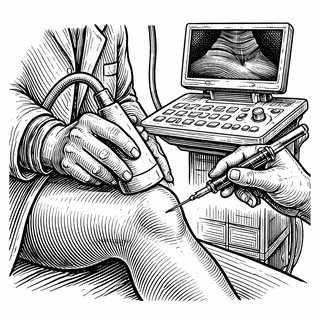
Ultrasound-guided injection is exactly what it sounds like: using a real-time ultrasound image to see the needle as it enters the joint. The doctor holds a small ultrasound probe against your knee, watches the screen to identify the joint space, and guides the needle under direct visualization.
It's the difference between parallel parking with backup cameras versus doing it blind while someone yells "LEFT! LEFT! NO, YOUR OTHER LEFT!" from the passenger seat.
A systematic review published in Arthroscopy, Sports Medicine, and Rehabilitation analyzed 12 Level I randomized controlled trials involving over 1,400 patients (Daley et al., 2021, DOI: 10.1016/j.asmr.2021.03.006). The findings were striking:
- Ultrasound-guided injections achieved 95.8% accuracy
- Blind/landmark-guided injections achieved 77.8% accuracy
- The odds ratio was 6.4 - meaning ultrasound-guided injections were more than six times more likely to hit the target
That's not a subtle difference. That's the difference between a professional basketball player and me trying to shoot free throws after three beers.
But Wait, Does Accuracy Actually Lead to Better Outcomes?
This is where it gets really interesting. It's one thing to say the needle went where it was supposed to; it's another to show that patients actually do better.
Rethinking viscosupplementation research has started asking exactly this question. A study using an objective surgical outcome - whether patients eventually needed knee replacement surgery - found that patients receiving ultrasound-guided HA injections were significantly less likely to undergo subsequent knee arthroplasty than those receiving landmark-guided injections (Berkoff et al., 2019, DOI: 10.1097/JSM.0000000000000803).
Think about that. Getting the needle in the right spot might actually delay or prevent the need for knee replacement surgery. That's not just a statistical footnote - that's a potential life-changing difference in outcomes.
Patient-reported outcomes also favor ultrasound guidance. Studies comparing the two approaches have found that WOMAC pain and function subscale scores improve significantly more with ultrasound-guided injections. The mean improvements in WOMAC pain scores are substantially higher when the injection actually goes where it's supposed to (Jang et al., 2017, DOI: 10.1007/s00296-017-3787-3).
NCT07266714: What's Being Studied
Clinical trial NCT07266714 is directly comparing ultrasound-guided versus conventional intra-articular hyaluronic acid injection. This kind of head-to-head comparison is exactly what the field needs - not just accuracy studies showing that ultrasound hits the target more often, but clinical outcome studies showing that patients actually feel better and function better.
The trial will help answer lingering questions about whether the extra time and equipment required for ultrasound guidance are worth it in everyday clinical practice. If ultrasound-guided injection leads to meaningfully better outcomes, it could change how knee injections are performed worldwide.
The Counterargument: Why Isn't Everyone Using Ultrasound Already?
If ultrasound guidance is so much better, why isn't it standard practice? Several reasons:
Time: Setting up for ultrasound-guided injection takes longer than just feeling for landmarks and injecting. In a busy clinic, that extra time adds up.
Equipment: Not every office has an ultrasound machine, and the ones that do need trained personnel to operate them.
Cost: Ultrasound-guided procedures are sometimes billed at higher rates, which can affect insurance coverage and out-of-pocket costs.
"Blind is good enough": Some practitioners argue that with experience, blind injection accuracy is high enough that routine ultrasound isn't necessary. The counterargument is that "high enough" still means missing 15-25% of the time, and you can't know which patients are in that unlucky group until it's too late.
Patient selection matters: In thin patients with straightforward anatomy, blind injection accuracy can approach ultrasound-guided levels. The real value of ultrasound may be in challenging cases - obese patients, difficult anatomy, or when previous injections haven't worked.
The Bottom Line: Seeing Is Believing
Here's my take: if someone is going to stick a needle into my joint and inject expensive medication that only works if it's in the right place, I want them to actually look at where the needle is going. The existing evidence strongly suggests that ultrasound guidance improves accuracy, and emerging evidence suggests this translates into better clinical outcomes.
Trial NCT07266714 will add to this evidence base, hopefully helping establish clearer guidelines for when ultrasound guidance should be used. My prediction? We'll eventually look back on routine blind knee injections the way we now look back on surgery without anesthesia - technically possible, but why would you do that to someone?
In the meantime, if you're scheduled for a knee injection, it might be worth asking your doctor about ultrasound guidance. The technology exists, the evidence supports it, and your knee deserves the best possible chance of actually receiving the medication you're paying for.
After all, you wouldn't hire a darts player who only hits the bullseye two-thirds of the time. Why accept worse odds for your own body?
References:
- ClinicalTrials.gov Identifier: NCT07266714
- Daley, E.L., et al. (2021). Ultrasound-Guided Knee Injections Are More Accurate Than Blind Injections: A Systematic Review of Randomized Controlled Trials. Arthroscopy, Sports Medicine, and Rehabilitation. DOI: 10.1016/j.asmr.2021.03.006
- Berkoff, D.J., et al. (2019). Rethinking Viscosupplementation: Ultrasound- Versus Landmark-Guided Injection for Knee Osteoarthritis. Clinical Journal of Sport Medicine. DOI: 10.1097/JSM.0000000000000803
- Jang, S.H., et al. (2017). A randomized blinded comparative study of clinical response to surface anatomy guided injection versus sonography guided injection of hyaluronic acid in patients with primary knee osteoarthritis. Rheumatology International. DOI: 10.1007/s00296-017-3787-3
Disclaimer: This blog post is for informational purposes only and does not constitute medical advice. Treatment decisions should be discussed with qualified healthcare providers who can evaluate your specific situation. The author has no financial relationship with any ultrasound equipment manufacturers or hyaluronic acid products mentioned in this article. Images and graphics are for illustrative purposes only and do not depict actual medical devices, procedures, mechanisms, or research findings from the referenced studies.