
Your blood has exactly one job when it escapes a vessel: clot, and fast. It's remarkably good at this, deploying a cascade of proteins and platelets so elegant it makes a Swiss watch look like a potato clock. And yet, for all its sophistication, sometimes the body's clotting machinery needs backup - particularly in trauma, surgery, or battlefield medicine, where "wait for your fibrin to sort itself out" isn't a viable treatment plan. Enter the hemostatic sponge: a deceptively simple piece of material engineering designed to accelerate what your body already wants to do.
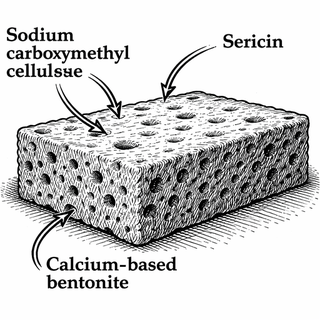
A team of researchers recently published work on a new kind of hemostatic sponge that reads like a recipe from a very nerdy kitchen. The ingredients? Sodium carboxymethyl cellulose (a plant-derived polymer beloved by the food industry), sericin (a protein extracted from silk), and calcium-based bentonite (fancy clay). The secret sauce? Drying the whole thing at room temperature without it collapsing into a sad, flat pancake.
The Collapse Problem Nobody Talks About
Here's the thing about making porous sponges - those tiny holes matter. A hemostatic sponge works because its porous structure rapidly absorbs blood, concentrates clotting factors, and gives platelets a surface to grab onto. It's like a microscopic scaffold for your body's construction crew.
Most high-performance sponges are made using freeze-drying (lyophilization), which preserves the porous structure beautifully but requires specialized equipment, low temperatures, and the kind of energy bill that makes your accountant weep. Ambient pressure drying (APD) - basically letting things dry in normal conditions - is cheaper, safer, and more energy-efficient. The catch? When water evaporates from tiny pores, capillary forces crush the delicate internal architecture like a soda can in a hydraulic press.
Imagine building a cathedral out of wet sand and then waiting for it to dry. That's essentially the challenge. The water's surface tension, as it retreats from those microscopic channels, generates enough inward force to flatten the whole structure. Elegant problem. Annoying problem.
The Ethanol Swap: A Bartender's Approach to Biomaterials
The researchers' solution is satisfyingly clever. Before drying, they replaced the water inside the sponge with ethanol through solvent exchange. Ethanol has significantly lower surface tension than water, which means the capillary forces generated during evaporation are dramatically reduced. It's the biomaterials equivalent of deflating a balloon slowly instead of popping it - same endpoint, much less structural carnage.
This isn't an entirely new trick in materials science, but applying it to a multi-component hemostatic sponge while maintaining both the structural integrity and the biological activity of each ingredient is the real achievement here.
The Ingredients List, Decoded
Let's break down what's actually in this sponge, because the component selection is where the cleverness really lives.
Sodium carboxymethyl cellulose (CMC) is a water-soluble polymer derived from cellulose - the stuff that makes plant cell walls rigid. It's already FDA-approved and shows up in everything from ice cream to surgical dressings. In this sponge, CMC provides the structural backbone and contributes to blood absorption.
Sericin (SS) is the protein that coats raw silk fibers. For decades it was literally discarded as waste during silk processing - millions of tons of it, flushed away. Turns out sericin has excellent biocompatibility, promotes cell adhesion, and has anti-inflammatory properties. Using a silk-industry waste product as a biomedical material is the kind of circular economy story that warms even the most cynical heart.
Calcium-based bentonite (ACBT) is a modified clay mineral. Clays have been used in wound healing since antiquity (there's a reason mud poultices are a thing in every traditional medicine system on the planet). Calcium ions are direct participants in the coagulation cascade, and bentonite's layered structure provides massive surface area for blood component activation. The clay isn't just filler - it's doing real biochemical work.
The researchers describe electrostatic coordination between CMC, sericin, and iron ions (from the bentonite modification), creating a cross-linked network that maintains its 3D porous architecture even after ambient pressure drying. The components aren't just mixed together; they're interacting at the molecular level to reinforce each other.
Why This Matters Beyond the Lab Bench
Hemostatic materials are a surprisingly competitive field, and for good reason. Uncontrolled hemorrhage remains a leading cause of preventable death in both military and civilian trauma. Current commercial hemostatic products work well but tend to be expensive, sometimes require cold-chain storage, and are manufactured using energy-intensive processes.
A sponge that can be produced at ambient pressure - no freeze dryers, no vacuum chambers, no liquid nitrogen - using biocompatible materials that include an industrial waste product (sericin) and an abundant natural mineral (bentonite) has obvious appeal for resource-limited settings. Think rural clinics, disaster response kits, military field medicine, or healthcare systems in developing nations where a $50 hemostatic dressing is a non-starter.
The researchers report "excellent hemostatic performance and biocompatibility," which in academic-speak means the sponge stopped bleeding effectively in their test models and didn't cause obvious tissue damage. That's promising, though the usual caveats apply: in vitro and animal model results don't automatically translate to human clinical performance.
The Bigger Picture
This work fits into a broader trend in biomaterials research - moving away from expensive, energy-intensive manufacturing toward simpler, greener production methods without sacrificing performance. Freeze-drying has been the gold standard for porous biomaterials for decades, but it's increasingly clear that clever chemistry can achieve similar structural outcomes through gentler means.
The solvent exchange approach demonstrated here could have applications well beyond hemostatic sponges. Any field that needs lightweight, porous materials - tissue engineering scaffolds, drug delivery systems, wound dressings, filtration membranes - could potentially benefit from ambient pressure drying methods that preserve microstructure.
There's also something satisfying about the ingredient list. Cellulose from plants. Protein from silk waste. Clay from the ground. Assembled at room temperature. It's not quite "things you could find in your backyard," but it's remarkably close to it for a high-performance biomedical material.
Of course, this is still early-stage research. The road from "promising lab results" to "thing your surgeon actually uses" is long, expensive, and paved with regulatory paperwork. But the fundamental approach - cheap materials, simple manufacturing, solid performance - checks a lot of boxes that matter for real-world adoption.
Sometimes the best innovations aren't about inventing something entirely new. Sometimes they're about figuring out how to make something useful without needing a quarter-million-dollar freeze dryer to do it.
This blog post discusses research findings and should not be taken as medical advice. If you have concerns about wound healing or bleeding disorders, please consult a healthcare provider. Research discussed here represents ongoing scientific investigation and clinical validation is still in progress.
All images used in this post are decorative illustrations only and do not represent or reflect the accuracy, reality, or correctness of the referenced research.
Primary Source: Sodium carboxymethyl cellulose/sericin/calcium bentonite rapid hemostatic sponge fabricated by ambient pressure drying with excellent hemostatic performance and biocompatibility. PubMed: 41962721