
When the cochlear implant arrived in the 1970s, it did something that sounded like science fiction: it translated sound into electrical signals the brain could interpret, giving deaf patients a version of hearing that had never existed before. It was clunky, controversial, and it changed millions of lives. Now, a team of researchers is chasing the same dream for vision, but with a twist that would make any hardware startup founder salivate: instead of zapping retinal cells with electricity, they're using microscopic gold pillars and pulses of light to gently warm neurons into action.
Welcome to the world of photothermal neuromodulation, where the pitch deck practically writes itself.
The Problem With Shocking Eyeballs
Current retinal prostheses - the ones that exist today, like the now-discontinued Argus II - work by sending electrical signals directly to the remaining retinal cells. Think of it as a tiny lightning storm in your eye. It works, sort of, but it comes with baggage. Electrical stimulation spreads out unpredictably, activating neurons you didn't intend to hit. Resolution is low (we're talking maybe 60 pixels of useful vision). Electrode arrays corrode over time. And the tissue interface? Let's just say your retina wasn't designed to be a circuit board.
For years, researchers have been hunting for something better. Something that could target individual neurons with precision, respond fast enough to keep up with real-time vision, and not slowly dissolve inside someone's eye. That's a tall order.
Enter the Gold Nanorods on Tiny Flexible Pillars
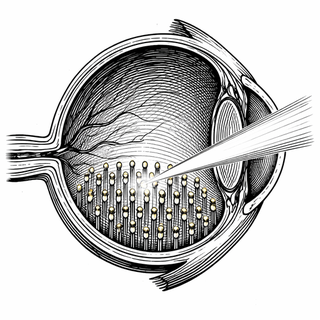
This new study introduces what I can only describe as the most elegantly overengineered piece of biotech I've seen this quarter: a flexible array of microscopic pillars made from PDMS (that's the same silicone-like material in contact lenses and medical implants) with gold nanorods glued specifically to the tips.
Here's why this is clever. Gold nanorods have a party trick - when you hit them with near-infrared light (the kind that passes harmlessly through tissue), they convert that light energy into heat with remarkable efficiency. This is called the plasmonic photothermal effect, and it's been known for a while. But previous approaches just dumped gold nanoparticles randomly onto a surface and hoped for the best. Imagine trying to play piano by throwing handfuls of keys at a keyboard. Not exactly precision engineering.
By anchoring the nanorods only at the pillar tips, this team created a deterministic interface. Every heating point is exactly where they put it. The pillars are flexible enough to conform to the curved surface of the retina. And because the gold is at the tips - right where the neurons sit - the thermal energy goes precisely where it needs to go.
If I were pitching this to investors, the slide would say: "We put the heater where the customer is."
Millisecond Speed, and They Can Prove It
One of the most impressive claims in this paper is the temporal resolution. Neurons fire on millisecond timescales. If your stimulation device can't keep up, you're basically trying to stream 4K video on dial-up. Previous photothermal approaches hadn't convincingly demonstrated that they could generate and dissipate heat fast enough.
Using infrared thermography with millisecond resolution, the researchers mapped exactly how quickly the pillar tips heat up when hit with near-infrared pulses. This is, according to the authors, the first experimental verification of such rapid thermal transients in gold nanorod-based neuromodulation. They backed it up with finite element modeling showing the heat stays spatially confined - a temperature bump of 2-6 degrees Celsius, right at the interface. That's the sweet spot: warm enough to modulate neuronal activity, cool enough not to cook anything.
From a product development standpoint, this is the kind of data that moves you from "interesting concept" to "fundable prototype."
The Cells Like It
Any device that's going to live on someone's retina needs to play nice with biological tissue. The team cultured retinal progenitor cells directly on the micropillar arrays, and the results were encouraging. The cells not only survived - they proliferated, extended dendrites, and physically attached themselves to the pillar interface. When the researchers fired near-infrared pulses at the arrays, the cells showed consistent calcium responses, which is the biological shorthand for "yes, these neurons are actually being activated."
Biocompatibility plus functional activation. That's the two-punch combo every medical device needs. You can have the most elegant engineering in the world, but if the cells reject it or ignore it, you're selling expensive paperweights.
Why This Matters for the Vision Restoration Market
Let's talk market for a second. The World Health Organization estimates that at least 2.2 billion people worldwide have some form of vision impairment. Retinal degenerative diseases like retinitis pigmentosa and age-related macular degeneration affect tens of millions, and current treatment options range from "slow the progression" to "sorry." The retinal prosthesis space has been plagued by device failures, company shutdowns, and underwhelming clinical outcomes.
This research represents a fundamentally different hardware approach. Light-addressable (no wires corroding inside the eye), conformal (fits the retina's shape), deterministic (every stimulation point is engineered), and fast (millisecond dynamics). If this platform can scale from bench to clinical trials, it could represent a generational leap in how we think about artificial vision.
The flexible PDMS substrate is already a well-understood biomaterial. Gold nanorods are manufacturable. Near-infrared light sources are cheap. The individual components aren't exotic - it's the assembly and the interface engineering that's novel. That's actually good news for commercialization, because it means you're not waiting on some miracle material to be invented.
What Comes Next
This is still early-stage work. The team demonstrated biocompatibility and function with retinal progenitor cells in a lab setting, not in a living eye. The jump from cultured cells to animal models to human trials is long, expensive, and full of pitfalls. We don't yet know how these arrays perform over months or years of chronic implantation, how the gold nanorods hold up under millions of stimulation cycles, or whether the thermal precision holds in the messy, wet, moving environment of a real eyeball.
But the foundation is solid. The physics works. The biology cooperates. The temporal dynamics are proven. For a field that's been searching for its next breakthrough since the cochlear implant showed what neural prostheses could achieve, this is a genuinely exciting piece of the puzzle.
Sometimes the best startups are the ones that take existing materials, arrange them in a smarter way, and solve a problem everyone else thought required something completely new. Gold at the tip of a tiny pillar, warmed by a flash of invisible light, nudging a neuron back to life. That's not just good science - that's a product waiting to happen.
This blog post discusses research findings and should not be taken as medical advice. If you have concerns about retinal degeneration or vision loss, please consult a healthcare provider. Research discussed here represents ongoing scientific investigation and clinical validation is still in progress.
All images used in this post are decorative illustrations only and do not represent or reflect the accuracy, reality, or correctness of the referenced research.
Primary Source: Tip-Functionalized Gold Nanorod Micropillar Arrays for Millisecond-Resolved Photothermal Neuromodulation Toward Retinal Prosthetic Applications. PubMed ID: 41937372