
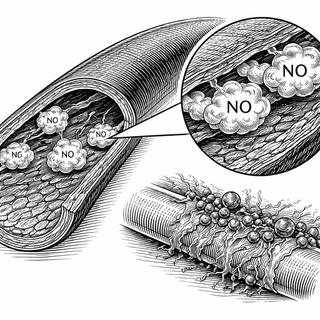
Quick - name the last time you thought about the inside of your blood vessels. Unless you're a hematologist or someone who just watched a very niche documentary, I'll guess: never. And yet, the endothelium - that impossibly thin layer of cells lining every vessel in your body - is pulling off one of biology's great magic tricks every second of your life. It keeps your blood flowing, fights off bacterial invaders, and prevents clots from forming where they shouldn't. It does this, in part, by constantly puffing out tiny clouds of nitric oxide gas, like a molecular bouncer keeping troublemakers away from the velvet rope.
Now here's the problem. Every catheter, every implant, every sensor we slide into the human body is, by comparison, about as sophisticated as a brick. And your blood knows it.
The Two-Minute Betrayal
I spent the better part of thirty years watching proteins misbehave on surfaces, and I can tell you: the moment a medical device touches blood, the game is already lost. Within seconds - literally seconds - a layer of plasma proteins slams onto that foreign surface like fans rushing a concert stage. This phenomenon, first described by Leo Vroman back in the 1960s, follows a predictable hierarchy. Fibrinogen and other procoagulant proteins muscle their way to the front, and once they're settled in, they start waving flags at platelets and the coagulation cascade. Translation: clotting begins.
Meanwhile, bacteria - opportunistic little creatures that they are - also notice the new real estate. They latch onto the protein-coated surface and start building biofilms, those slimy fortresses that antibiotics can barely touch. So now you've got clotting AND infection, both triggered by a surface that's basically advertising "not from around here."
This dual failure has plagued medical devices for decades. Catheters clot. Implants get infected. Sometimes both at once, which is the biomedical equivalent of your house flooding during a fire.
A Coating That Thinks Like an Artery
A recent study published in 2025 tackles this old problem with a genuinely clever two-pronged approach. The research team developed what they call "NOBD" - a hybrid surface technology that combines nitric oxide release with selective protein recruitment. The name isn't exactly catchy, but what it does is rather elegant.
Here's the recipe. Start with polydimethylsiloxane (PDMS), a silicone rubber commonly used in medical devices. Infuse it with S-nitroso-N-acetylpenicillamine, or SNAP - a molecule that slowly decomposes to release nitric oxide. Then coat the surface with blue dextran, a modified sugar polymer that has a well-known fondness for albumin.
Why albumin? Because albumin is the wallflower protein you actually want at the party. It's the most abundant protein in blood plasma, and unlike fibrinogen, it doesn't activate clotting. If you can get albumin to dominate the surface and stay there, you've essentially built a molecular shield. The blue dextran acts like a selective doorman: albumin gets the VIP pass while fibrinogen and its procoagulant friends get turned away.
Two Weapons, One Surface
The beauty of NOBD is that it doesn't rely on a single defense. The blue dextran handles the protein problem, and the nitric oxide handles everything else.
NO release from the surface was shown to remain within physiological vascular levels - between 0.5 and 4.0 times 10 to the negative tenth mol per square centimeter per minute - for over 24 hours under physiological conditions. That's the same range your own endothelial cells operate in. At these levels, nitric oxide does two things beautifully: it tells platelets to calm down and stop aggregating, and it poisons bacteria trying to set up camp.
I've seen dozens of NO-releasing materials come through the literature over the years. What makes this work stand out is the combination. Previous approaches often addressed either clotting or infection, rarely both simultaneously. The Vroman effect - where initially adsorbed albumin gets displaced by more "sticky" proteins like fibrinogen over time - has been a persistent headache. Blue dextran's strong albumin affinity helps resist that displacement, which is a meaningful advance. Surface characterization confirmed the NOBD coating maintained stability throughout the 24-hour testing period, suggesting this isn't just a flash-in-the-pan effect.
Why This Matters Beyond the Lab Bench
Let me put some numbers in perspective. Catheter-related bloodstream infections affect an estimated 250,000 patients annually in the United States alone, according to CDC data. Device-associated thrombosis adds another layer of morbidity. These aren't rare complications - they're routine nightmares for intensive care units worldwide.
If a surface technology can simultaneously reduce protein-driven clotting and bacterial colonization while maintaining stability under real physiological conditions, the implications stretch across virtually every blood-contacting medical device: central venous catheters, dialysis circuits, ECMO tubing, vascular grafts, biosensors. The list is long because the problem is universal.
Of course - and I say this as someone who has watched many promising lab results stumble on the path to clinical reality - there's a considerable distance between 24-hour in vitro stability and years of reliable performance inside a human body. Long-term NO donor depletion, the durability of the blue dextran coating under shear stress, manufacturing scalability, and regulatory approval all remain open questions. The SNAP donor will eventually run out of nitric oxide to give, and what happens to the surface then is something future studies will need to address.
The Long Game
Still, there's something deeply satisfying about watching materials science catch up to biology. For decades, we've known exactly what the endothelium does right - selective protein management, antiplatelet signaling, antimicrobial defense - and we've been trying to copy it with varying degrees of success. NOBD represents one of the more thoughtful attempts I've seen: rather than mimicking one endothelial function in isolation, it layers two complementary strategies into a single surface.
It reminds me of something a colleague told me years ago in a biomaterials seminar: "The body isn't stupid. If you want to fool it, you'd better bring more than one trick." NOBD brings two, and based on the early data, they work better together than either would alone. That's not just good engineering. That's good thinking.
This blog post discusses research findings and should not be taken as medical advice. If you have concerns about medical device complications or blood-contacting implants, please consult a healthcare provider. Research discussed here represents ongoing scientific investigation and clinical validation is still in progress.
All images used in this post are decorative illustrations only and do not represent or reflect the accuracy, reality, or correctness of the referenced research.
Primary Source: Nitric oxide-releasing dextran surface with enhanced albumin affinity mitigates infection and foreign body reaction. PubMed. 2025. PMID: 41617275