
In the 1920s, when the chemical industry was booming and environmental regulation was essentially "dump it wherever," factories producing dyes, pesticides, and pharmaceuticals routinely flushed their waste straight into rivers. Nobody thought twice about compounds like 4-nitrophenol ending up in the water supply. Fast forward a century, and we're still cleaning up that kind of mess - except now we know exactly how toxic those compounds are, and we're finally getting clever about neutralizing them. A new study has just shown that a spongy material made from bacterial cellulose, guar gum, and teensy silver nanoparticles can break down one of the most persistent water pollutants in under four minutes flat.
Wait, What's 4-Nitrophenol and Why Should I Care?
4-Nitrophenol (4-NP for short, because chemists love abbreviations) is a pale yellow organic compound that shows up as a byproduct in the manufacturing of pesticides, synthetic dyes, pharmaceuticals, and even explosives. It's on the U.S. EPA's priority pollutant list, and for good reason: it's toxic to aquatic life, potentially carcinogenic to humans, and stubbornly resistant to natural degradation. Once it gets into a waterway, it likes to stick around.
Traditional methods for removing 4-NP from water include adsorption, microbial degradation, and advanced oxidation processes. These work, but they tend to be slow, expensive, energy-intensive, or some delightful combination of all three. What researchers really want is something cheap, reusable, and fast. Enter the "dip catalyst."
The World's Most Overachieving Sponge
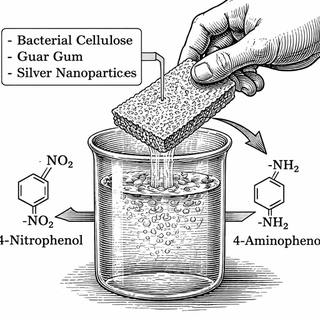
The research team behind this study took a refreshingly practical approach. They started with bacterial cellulose - a material produced by bacteria that forms an incredibly fine, strong nanofiber network. Think of it as nature's version of a very fancy paper towel. They then blended it with guar gum (yes, the same stuff that thickens your ice cream and salad dressing) and crosslinked the whole thing with borate to make it sturdy.
Then came the magic ingredient: silver nanoparticles, synthesized directly within the matrix. The team tested three different silver concentrations - 1.0, 2.5, and 5.0 millimolar - to find the sweet spot. Silver at the nanoscale is a well-known catalytic powerhouse. When particles shrink to just a few nanometers across, their surface area relative to their volume skyrockets, giving them extraordinary reactivity.
The resulting composite is essentially a solid, reusable pad that you can dip into contaminated water, and it gets to work immediately. No need for complicated reactor setups, high temperatures, or specialized equipment. Dip it in, pull it out, rinse, repeat.
Four Minutes to Clean Water
The standout performer was the composite loaded with 2.5 mM silver (dubbed BC-GG-Ag2.5 by the team, because catchy naming isn't really chemistry's strong suit). This version achieved complete conversion of 4-nitrophenol to 4-aminophenol - a far less harmful compound - in just four minutes. The apparent rate constant clocked in at 0.630 per minute, which, in the world of catalytic pollutant reduction, is genuinely impressive.
Interestingly, more silver wasn't better. The 5.0 mM version didn't outperform the 2.5 mM one, likely because at higher concentrations the nanoparticles tend to clump together, reducing that precious surface area. It's a Goldilocks situation: too little silver and the reaction crawls, too much and the particles get crowded and lazy.
Under the Hood: What the Characterization Revealed
The team didn't just make the material and call it a day. They threw a battery of analytical techniques at it to understand what was actually happening at the nanoscale.
X-ray diffraction (XRD) confirmed that the silver had formed proper face-centered cubic crystalline nanoparticles, with sizes ranging from 3.6 to 7.7 nanometers. For perspective, a human hair is about 80,000 nanometers wide. These particles are absurdly small.
Scanning electron microscopy (SEM) showed the silver nanoparticles distributed throughout the bacterial cellulose-guar gum matrix, while Brunauer-Emmett-Teller (BET) measurements revealed that incorporating silver affected the composite's surface area - a key factor in catalytic performance.
Fourier transform infrared spectroscopy (FTIR) confirmed the chemical interactions between the guar gum, cellulose, borate crosslinker, and silver. In short, everything was playing nicely together at the molecular level.
Why This Matters Beyond the Lab
The beauty of this approach is in its simplicity and sustainability. Bacterial cellulose is produced by microorganisms and is biodegradable. Guar gum comes from guar beans and is dirt cheap. Silver, while not free, is used in tiny quantities at the nano level. And because this is a dip catalyst - a solid material you physically dunk into contaminated water - you can pull it out and reuse it, which dramatically cuts costs and waste compared to single-use chemical treatments.
There's also something appealing about turning food-grade ingredients into environmental cleanup tools. Guar gum goes from thickening your smoothie to scrubbing industrial pollutants from waterways. Bacterial cellulose goes from wound dressings and vegan leather experiments to pollution remediation. It's the kind of material science crossover episode that makes you appreciate how versatile natural polymers really are.
The Road Ahead
As with all lab-scale demonstrations, the big question is scalability. Can you produce enough of this composite material to treat real-world volumes of contaminated water? How many dip-and-pull cycles can it survive before the silver washes out or the matrix degrades? And how does it perform when the water contains a cocktail of pollutants rather than just 4-NP in isolation?
These are the questions that separate a cool proof-of-concept from a deployed technology, and they'll need answering before this spongy little catalyst finds its way into wastewater treatment plants. But the fundamentals are solid: cheap materials, simple fabrication, fast performance, and reusability. That's a strong starting lineup.
For now, this research adds another promising entry to the growing catalog of nanocomposite catalysts for environmental remediation. And honestly, any technology that can turn a priority pollutant into something harmless in the time it takes to brew a cup of coffee deserves a closer look.
This blog post discusses research findings and should not be taken as medical advice. If you have concerns about environmental pollutant exposure, please consult a healthcare provider. Research discussed here represents ongoing scientific investigation and clinical validation is still in progress.
All images used in this post are decorative illustrations only and do not represent or reflect the accuracy, reality, or correctness of the referenced research.
Primary Source: Silver nanoparticles embedded in borate-crosslinked guar gum-bacterial cellulose composite dip catalyst for efficient 4-nitrophenol reduction. PubMed. 2026. PMID: 41933766