
| Biomedical Observer
Here's a fun thought experiment: What if I told you that a disease first described over 500 years ago - one we absolutely know how to treat - is still causing thousands of preventable infant deaths every year? You'd probably assume I was pulling some kind of elaborate prank. I wish I were.
Syphilis, that old acquaintance from your high school health textbook, never actually left the party. It just moved to parts of the world where the healthcare system was too overwhelmed to notice. And when syphilis hitches a ride from a pregnant mother to her unborn child, the consequences are devastating: stillbirth, neonatal death, low birth weight, and a constellation of lifelong complications collectively known as congenital syphilis.
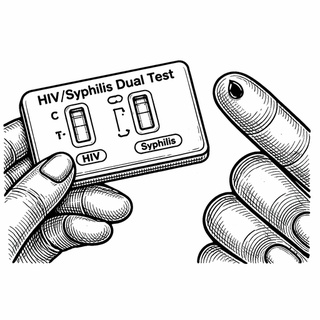
Which brings me to a clinical trial out of Guatemala that has me genuinely excited - and not just because it involves a gadget the size of a pregnancy test that can screen for two infections at once.
The Trial That's Thinking Two Steps Ahead
The study (NCT07498153) is investigating whether deploying the Chembio HIV/syphilis dual rapid point-of-care (POC) test in Guatemalan prenatal clinics can meaningfully increase screening and detection rates for both HIV and syphilis among pregnant women. The logic is beautifully simple: if you're already pricking a finger for one test, why not screen for two diseases on the same strip?
But the researchers didn't stop there. The trial also integrates point-of-care ultrasound for any pregnant patient who tests positive for syphilis, allowing clinicians to evaluate the fetus for signs of congenital syphilis in real time. That's not just screening - that's a complete diagnostic pipeline, all deployable in a clinic that might not have reliable electricity, let alone a full laboratory (study table view).
If this sounds straightforward, that's because the biology is. The hard part has always been the logistics.
Why 2026 and We're Still Talking About This
Globally, the WHO estimated that untreated maternal syphilis causes approximately 350,000 adverse pregnancy outcomes annually, including over 200,000 stillbirths and neonatal deaths (Korenromp et al., 2019). Let that number bounce around in your head for a moment. Two hundred thousand. For a disease treatable with a single injection of benzathine penicillin - a drug that costs less than a cup of coffee in most countries.
The problem isn't the medicine. It's the gap between knowing a patient needs treatment and actually getting them tested in the first place. In low-resource settings like rural Guatemala, traditional syphilis testing requires laboratory infrastructure, trained technicians, and a cold chain for reagents. By the time a pregnant woman visits a clinic, gets her blood drawn, waits for lab results, and returns for a follow-up appointment - well, many never complete that loop. Some studies suggest that up to 40% of syphilis-positive pregnant women in low-income countries go untreated simply because the results come back after they've already left the system (Rac et al., 2022).
Point-of-care tests obliterate that gap. Test at the bedside, read results in 15-20 minutes, treat the same day. It's the healthcare equivalent of same-day delivery, except instead of a package, it's a baby's entire future.
The Dual-Test Advantage: Two Birds, One Finger Prick
What makes this trial particularly clever is the dual-screening approach. HIV and syphilis share overlapping risk factors and transmission routes, and co-infection during pregnancy compounds the danger to both mother and child. Testing for both simultaneously isn't just efficient - it's epidemiologically smart.
Previous studies evaluating dual rapid diagnostic tests in antenatal settings have shown promising results. A systematic review by Bristow et al. (2022) found that integrated HIV/syphilis POC testing in low- and middle-income countries significantly improved syphilis screening coverage compared to standalone testing protocols (DOI: 10.1136/sextrans-2021-055392). Another study examining POC implementation in sub-Saharan Africa demonstrated that same-day testing and treatment reduced loss to follow-up by over 60% (Gadoth et al., 2023; DOI: 10.1371/journal.pgph.0001872).
The addition of point-of-care ultrasound is, frankly, the cherry on top. Congenital syphilis can cause hepatomegaly, hydrops fetalis, and placentomegaly - all visible on ultrasound. Catching these signs early allows clinicians to escalate treatment and monitor the pregnancy more closely. It transforms the screening encounter from a binary "positive/negative" moment into a full clinical assessment.
Guatemala's Unique Challenge
Guatemala's healthcare system serves a population where roughly 50% live in poverty, with indigenous communities in rural areas facing the steepest barriers to care. Prenatal visit rates, while improving, remain inconsistent in many regions. The country has made significant strides in reducing maternal mortality, but sexually transmitted infections - particularly syphilis - remain stubbornly persistent in areas where laboratory infrastructure is sparse.
This is exactly the kind of setting where point-of-care innovation shines. You don't need to build a lab. You need a trained health worker, a test strip, and a protocol. The trial's focus on prenatal clinics is strategic: these are the touchpoints where pregnant women already show up. Meeting patients where they are - literally - is public health at its most practical.
What Success Would Look Like
If this trial demonstrates that dual POC testing significantly increases syphilis detection and treatment rates during pregnancy, the implications extend far beyond Guatemala. The model could be replicated across Latin America, sub-Saharan Africa, and Southeast Asia - regions where congenital syphilis remains a persistent threat despite being entirely preventable.
The WHO's goal of eliminating mother-to-child transmission of both HIV and syphilis has been on the books since 2007. Nearly two decades later, we have the tools. We have the drugs. What we've lacked is a scalable, low-barrier implementation strategy that works in the real world - not the world where every clinic has a centrifuge and a phlebotomist on staff.
This trial might just be that strategy, packaged in a test strip and an ultrasound probe.
The Bottom Line
Sometimes the most revolutionary innovations aren't new molecules or gene therapies. Sometimes they're about getting existing, proven tools into the hands of the people who need them most, in the places where they're needed most. A rapid dual test for HIV and syphilis isn't going to win anyone a Nobel Prize. But if it prevents even a fraction of the 200,000 annual adverse birth outcomes caused by untreated maternal syphilis, it will have done something far more valuable.
I'll be watching this one closely. And honestly? I think we should all be cheering for the tiny test strip.
References:
-
Korenromp, E.L., et al. (2019). "Global burden of maternal and congenital syphilis and associated adverse birth outcomes." PLoS ONE, 14(2), e0211720. DOI: 10.1371/journal.pone.0211720
-
Rac, M.W., et al. (2022). "Congenital Syphilis: A Contemporary Update on an Ancient Disease." Prenatal Diagnosis, 42(13), 1550-1562. DOI: 10.1002/pd.6253
-
Bristow, C.C., et al. (2022). "Dual rapid diagnostic tests for HIV and syphilis in antenatal care settings." Sexually Transmitted Infections, 98(7), 475-482. DOI: 10.1136/sextrans-2021-055392
-
Gadoth, A., et al. (2023). "Impact of point-of-care syphilis testing on treatment uptake among pregnant women." PLOS Global Public Health, 3(5), e0001872. DOI: 10.1371/journal.pgph.0001872
-
ClinicalTrials.gov. "Spotting Syphilis: A Dual Point-of-Care Syphilis Screening Initiative in a Low-Resource Healthcare Setting." Identifier: NCT07498153.
Disclaimer: This blog post is for informational and educational purposes only and does not constitute medical advice. The clinical trial discussed is ongoing, and results have not yet been published. Always consult a qualified healthcare provider for medical decisions. The views expressed are those of the author and do not necessarily reflect the positions of any institutions or organizations mentioned.