
If you've ever winced in the dentist's chair while they cemented a crown into place, silently wondering what exactly that goop is doing to the living tissue inside your tooth, you already understand the basic principle behind this research.
Turns out, your instinct to worry wasn't entirely paranoid. A new in vitro study just put several popular resin-based dental cements through a rigorous biological gauntlet, and the results read like a startup pitch deck where only one product survives due diligence. Spoiler: most of them failed the biocompatibility test.
The Problem No One Talks About at Dental Conferences (But Should)
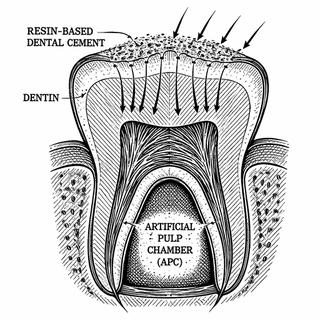
Here's the market landscape. Dentists have a whole shelf of resin-based cements to choose from when they're permanently attaching crowns, bridges, and other fixed prostheses to your teeth. These products promise excellent adhesion, great aesthetics, and easy handling. What the marketing brochures don't always emphasize is what happens when components from those cements leach through the dentin layer and reach the living pulp cells underneath.
Think of dentin as the biological firewall between the outside of your tooth and the soft, nerve-rich pulp tissue on the inside. It's porous. It has tiny tubules running through it like microscopic straws. And anything sitting on top of the dentin can, over time, seep through those tubules and interact with pulp cells. If you're a product manager thinking about total addressable market risk, this is the kind of thing that keeps you up at night.
The Experiment: Building a Tooth Simulator
The research team designed an elegant benchtop model to test this exact scenario. They collected 60 intact human third molars (wisdom teeth, donated to science instead of the trash can - truly a second life story) and sliced them into dentin disks. These disks were then fitted into artificial pulp chambers, or APCs, which are basically miniature simulations of the inside of a tooth.
On the outer surface of each dentin disk, they applied one of four resin-based materials:
- RelyX Luting 2 - a resin-modified glass ionomer cement
- RelyX U200 - a self-adhesive resin cement
- RelyX Ultimate - an adhesive resin cement
- Single Bond Universal - used here as a positive control (an adhesive system known to be somewhat irritating)
A negative control group got no treatment at all, just to establish baseline cell happiness.
After 24 hours, the team collected the culture medium that had been sitting on the pulp side of the dentin disk - essentially capturing whatever chemical components had diffused through. Then they applied these extracts to two types of cells: MDPC-23 cells (an odontoblast-like cell line commonly used in dental research) and human dental pulp cells (HDPCs). They measured cell viability, alkaline phosphatase activity, total protein content, and mineral nodule formation.
If this were a product launch, this is the part where QA stress-tests your product and emails you the results at 11 PM.
The Results: One Winner, Several Losers
Let's cut straight to the scoreboard.
RelyX U200 was the only cement that caused zero transdentinal toxicity to either cell type. That's it. That's the product-market fit winner right there.
The other resin-based materials all caused measurable reductions in cell viability, alkaline phosphatase activity (a marker of cell function and mineralization capability), total protein synthesis, and mineral nodule formation compared to the negative control. The cells exposed to these cement extracts were less alive, less functional, and less capable of doing their job.
RelyX Luting 2 performed the worst. It showed the most pronounced negative effects across nearly every metric. If this were a startup demo day, it would be the team whose live demo crashed in front of investors.
And here's an interesting wrinkle: the MDPC-23 odontoblast-like cells were consistently more sensitive to the toxic effects than the human dental pulp cells. This matters because odontoblasts are the cells responsible for forming dentin and maintaining the tooth's structural integrity. They're the front-line defenders, and they're taking the hardest hit.
Why This Matters Commercially (And Clinically)
The global dental cement market is projected to grow substantially over the next decade, driven by aging populations, increasing cosmetic dentistry demand, and expanding access to dental care in emerging markets. Every crown, every bridge, every veneer needs cement. That's billions of cementation procedures per year.
Now imagine you're a dental materials company looking at these results. You've got a product - RelyX U200 - that demonstrably outperforms competitors in biocompatibility testing. That's not just a clinical advantage; that's a marketing goldmine. "The only cement proven non-toxic to pulp cells in transdentinal diffusion testing" is the kind of claim that makes dental procurement officers pay attention.
For clinicians, this data is equally actionable. When you're cementing a restoration on a tooth with a thin remaining dentin layer - say, after aggressive preparation or on a young patient with wide-open dentinal tubules - your cement choice could meaningfully affect pulp cell health. Having evidence-based guidance on which products are least likely to harm the underlying tissue is exactly the kind of data that should inform clinical decision-making.
The Bigger Picture
This study highlights something the dental materials industry sometimes overlooks in the rush to optimize mechanical properties and handling characteristics: biological safety matters. A cement can have perfect bond strength and beautiful color matching, but if it's quietly poisoning the cells underneath, you've got a long-term problem that mechanical testing alone will never catch.
The transdentinal diffusion model used here is particularly valuable because it mimics clinical reality more closely than simply dunking cells in cement extract. Dentin acts as a partial barrier, modifying and filtering the components that reach the pulp. Testing through that barrier gives you data that's actually relevant to what happens inside a real tooth.
For the dental materials market, the takeaway is clear: biocompatibility testing through dentin should be standard practice, not an afterthought. And for practitioners choosing between products, this study gives you at least one data point suggesting that self-adhesive resin cements like RelyX U200 might be the safer bet for pulp health.
The tooth, as it turns out, deserves a cement that respects the neighbors living downstairs.
This blog post discusses research findings and should not be taken as medical advice. If you have concerns about dental restorations or cement biocompatibility, please consult a healthcare provider. Research discussed here represents ongoing scientific investigation and clinical validation is still in progress.
All images used in this post are decorative illustrations only and do not represent or reflect the accuracy, reality, or correctness of the referenced research.
Primary Source: Transdentinal cytotoxicity of resin-based cements on odontoblast-like (MDPC-23) and human dental pulp cells. PubMed. 2025. PMID: 42034506