
Let's play Two Truths and a Lie. Ready? (1) The same motion capture technology used to animate Gollum in Lord of the Rings is now being strapped to kids who've had cancer surgery to study how they walk. (2) A child's walking pattern after orthopedic surgery can quietly deteriorate for years without anyone catching it during routine check-ups. (3) Doctors already have a comprehensive, standardized database of exactly how healthy kids walk at every age, so comparing cancer patients to normal is a piece of cake.
If you picked number three as the lie, congratulations - you're sharper than my kid after two juice boxes. The truth is, we've been surprisingly bad at systematically measuring how children should walk, which makes figuring out how cancer patients walk differently a whole lot harder. Enter the DEEPGAIT study, and suddenly things are getting very interesting.
What Exactly Is DEEPGAIT?
DEEPGAIT (because every good study needs an acronym that sounds like it belongs in a spy thriller) is a clinical trial (NCT07502885) designed to take an absurdly detailed look at how pediatric cancer patients walk after orthopedic surgery. We're talking about kids who've been treated for lower limb bone sarcomas, soft tissue sarcomas, or steroid-induced avascular necrosis - conditions where the surgery saves lives but can leave lasting marks on how a child moves through the world.
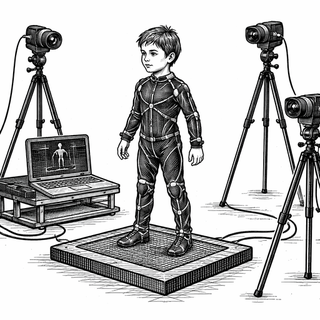
The study uses a tech stack that would make a video game studio jealous: 3D motion capture systems, electromyography (muscle sensors), force plates embedded in the floor, and wearable devices. If you've ever seen those behind-the-scenes clips of actors covered in little reflective dots while pretending to be aliens, you've got the general idea - except here the "actors" are brave kids, and the "movie" is their recovery.
Why Walking Matters More Than You Think
Here's something that keeps me up at night as a parent: a kid can look fine sitting in a doctor's office and still have significant gait problems that are slowly affecting their quality of life. Walking isn't just putting one foot in front of the other. It's a staggeringly complex symphony of muscle timing, joint angles, balance adjustments, and force distribution that happens hundreds of times a day without conscious thought.
When a child undergoes limb-salvage surgery or deals with avascular necrosis (where bone tissue dies due to reduced blood supply, often a side effect of steroid treatment in leukemia patients), that symphony can turn into something closer to jazz improvisation - creative, maybe, but not exactly what the body was designed to do long-term.
Research published in recent years has highlighted that functional impairments in pediatric sarcoma survivors can persist well beyond treatment completion, affecting physical activity levels, participation in sports, and overall well-being (Fernandez-Pineda et al., Pediatric Blood & Cancer, 2017). Studies have also shown that gait abnormalities after limb-salvage surgery are common, but detailed longitudinal data - tracking how these problems evolve over years - remains frustratingly sparse (Hasley et al., Frontiers in Pediatrics, 2021).
The "So What?" For Your Family
Let's say your child (heaven forbid) goes through cancer treatment involving leg surgery. Right now, the post-surgical rehab playbook is... let's call it "general." Physical therapists do their best with the tools they have, but without a clear picture of what specific gait deficits look like at 6 months, 1 year, or 5 years post-surgery, interventions can feel like throwing darts in the dark while wearing oven mitts.
DEEPGAIT aims to change that in two big ways:
First, the study is building a library of normative reference values - essentially a detailed map of how healthy kids of every age and sex walk. Think of it as creating the "answer key" that's been missing. Once you know what normal looks like down to the millimeter and millisecond, you can quantify exactly how far off a patient is and track whether they're getting better or worse.
Second, it's following patients for up to five years after surgery. That's huge. Most studies grab a snapshot and move on. DEEPGAIT wants the whole movie. This long-term tracking could reveal critical windows where intervention makes the biggest difference - or red flags that predict who's going to struggle down the road.
The Risk Factor Detective Work
Beyond just measuring how kids walk, DEEPGAIT is hunting for risk factors. What personal characteristics, disease features, treatment choices, or environmental conditions predict which kids will develop significant gait problems? This is the kind of question that, once answered, could reshape clinical decision-making.
Imagine a world where an oncologist can tell you: "Based on your child's profile, there's a higher risk of gait deficits at the one-year mark, so we're going to start targeted physical therapy at month three instead of waiting." That's not science fiction - that's the practical endpoint of this kind of research.
Studies on steroid-induced osteonecrosis in pediatric acute lymphoblastic leukemia (ALL) patients have shown that up to 70% of affected children develop clinically significant functional limitations, with limited evidence guiding rehabilitation strategies (te Winkel et al., Blood, 2014). The DEEPGAIT approach of combining biomechanical measurement with wearable device data could help bridge this gap between knowing there's a problem and knowing what to do about it.
Wearable Devices: The Game Changer
Perhaps the most parent-friendly aspect of DEEPGAIT is the inclusion of wearable devices. While 3D motion capture labs are incredible, they're also expensive, specialized, and require your kid to travel to a research center. Wearable sensors - think sophisticated step trackers on steroids (pun... kind of intended) - can capture movement data in the real world. At the playground. At school. During the messy, unpredictable reality of actual childhood.
If the study can validate wearable-based measurements against their gold-standard lab data, it opens the door to monitoring gait recovery at home. For parents already juggling oncology appointments, physical therapy schedules, and the general chaos of raising a human, that's not just convenient - it's transformative.
What This Means Going Forward
DEEPGAIT won't cure cancer. It won't even directly treat gait problems. What it will do - if successful - is give clinicians an unprecedented toolkit for understanding, measuring, predicting, and ultimately improving how pediatric cancer survivors walk through the rest of their lives. And when your kid has just fought through something as brutal as cancer treatment, knowing that someone is paying this much attention to their quality of life on the other side? That matters.
The study is currently recruiting participants, including both pediatric cancer patients and healthy controls. If you want to geek out on the full details (or see if your family might be eligible), the trial page has everything laid out: ClinicalTrials.gov - NCT07502885.
Disclaimer: This blog post is for informational and educational purposes only. It does not constitute medical advice. Clinical trials are complex, and individual results vary. Always consult with your child's healthcare team before making decisions about treatment or study participation. The information presented here is based on publicly available trial data and published research as of April 2026.
References:
-
ClinicalTrials.gov. Deep Phenotyping Gait Deficits in Orthopedic Manifestations of Pediatric Cancer Patients (DEEPGAIT). Identifier: NCT07502885. Available at: https://clinicaltrials.gov/study/NCT07502885
-
Fernandez-Pineda, I., et al. (2017). Long-term functional outcomes and quality of life in adult survivors of childhood extremity sarcomas. Pediatric Blood & Cancer, 64(4). https://doi.org/10.1002/pbc.26405
-
Hasley, I., et al. (2021). Functional outcomes following limb salvage surgery in pediatric bone tumors. Frontiers in Pediatrics, 9, 740267. https://doi.org/10.3389/fped.2021.740267
-
te Winkel, M.L., et al. (2014). Osteonecrosis in children with acute lymphoblastic leukemia. Blood, 124(26), 3932-3938. https://doi.org/10.1182/blood-2014-01-551267