
This research trial is about to be the most shared study in head and neck oncology - not because the results are in (they aren't), but because the concept sounds like something a slightly unhinged physicist pitched at a cocktail party. "What if we injected microscopic bubbles into cancer patients, then popped them with ultrasound to help immunotherapy drugs get inside tumors better?" Somehow, that pitch made it through an IRB. And honestly? The science behind it is surprisingly solid.
The trial in question (NCT07501650) is a feasibility study combining pembrolizumab - the blockbuster anti-PD-1 immunotherapy drug you might know as Keytruda - with ultrasound-induced microbubble cavitation in patients with recurrent or metastatic head and neck squamous cell carcinoma (R/M HNSCC). Let's break down what all of that actually means and why you should care.
Head and Neck Cancer: The Problem That Won't Quit
Head and neck squamous cell carcinoma is the sixth most common cancer worldwide, arising in tissues lining the mouth, throat, and voice box. When it comes back after initial treatment or spreads to distant sites, the outlook gets grim fast. Five-year survival rates for recurrent or metastatic disease hover stubbornly in the range of 5-15%, depending on the study you read.
Pembrolizumab changed the game somewhat. The landmark KEYNOTE-048 trial demonstrated that pembrolizumab - alone or combined with chemotherapy - improved overall survival compared to the prior standard of care in first-line R/M HNSCC (Burtness et al., The Lancet, 2019). It's now a go-to treatment. But here's the thing that keeps oncologists up at night: only about 15-20% of patients respond to pembrolizumab monotherapy. The drug works spectacularly when it works. For the majority, the tumor basically shrugs.
Why? One major reason is that immunotherapy drugs have trouble physically reaching enough of the tumor. Solid tumors are notoriously stingy about letting therapeutics through their abnormal vasculature. The drug is in your bloodstream doing laps, but the tumor's microenvironment is like a bouncer who doesn't care that you're on the list.
Enter the Microbubbles (No, Seriously)
This is where the trial gets creative - and where I need you to bear with me for a moment of physics.
Microbubbles are tiny gas-filled spheres, usually 1-10 micrometers in diameter, coated with a lipid or protein shell. The specific product used in this trial is Definity (perflutren lipid microspheres), which is already FDA-approved as an ultrasound contrast agent. Cardiologists use it every day to make echocardiograms look better. It's well-characterized, well-tolerated, and sitting right there on the shelf.
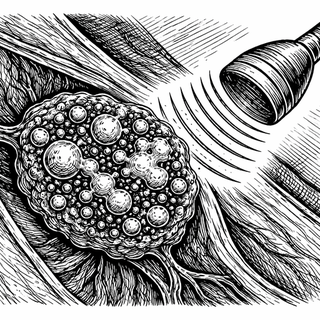
Here's the clever part. When you aim focused ultrasound at these microbubbles, they oscillate, expand, and collapse violently - a process called cavitation. That mechanical energy does something remarkable to the surrounding tissue: it temporarily opens up gaps in blood vessel walls and cell membranes, a phenomenon researchers call "sonoporation." Think of it as using tiny molecular jackhammers to briefly knock holes in the tumor's defenses, letting whatever drug is circulating in the blood flood in more effectively.
The concept has been explored with chemotherapy drugs, most notably in a pioneering human clinical trial combining ultrasound and microbubbles with gemcitabine in inoperable pancreatic cancer. That small study, led by Dimcevski and colleagues, showed the approach was safe and suggested improved tumor response (Dimcevski et al., Journal of Controlled Release, 2016). The broader science of sonoporation for drug delivery has been thoroughly reviewed and the preclinical evidence is genuinely encouraging (Deprez et al., Advanced Drug Delivery Reviews, 2021).
But applying this to immunotherapy - to a checkpoint inhibitor like pembrolizumab - that's a newer frontier. The hypothesis isn't just that you'll get more drug into the tumor. It's that the mechanical disruption from cavitation might also release tumor antigens, creating a kind of localized immune "wake-up call" that works synergistically with the PD-1 blockade. Preclinical work in murine models has shown that ultrasound-microbubble treatment can enhance anti-tumor immune responses, increase T-cell infiltration, and improve checkpoint inhibitor efficacy (Sheybani et al., Theranostics, 2020).
What the Trial Actually Involves
Let's pump the brakes and look at the trial design with a skeptic's eye - because while the concept is exciting, we're at the very beginning here.
This is a feasibility trial. Not a Phase II. Not a randomized controlled trial. A feasibility study. The primary endpoint isn't "does this cure cancer" - it's "can we actually recruit 6 patients within a year and have at least 80% of them complete the procedures without things falling apart logistically?"
Patients will receive three infusions of pembrolizumab spaced three weeks apart. After each infusion, focused ultrasound will be directed at the primary tumor site while Definity microbubbles are in circulation, inducing cavitation and (theoretically) enhancing drug penetration into the tumor.
Secondary endpoints include serious adverse events, clinical and radiographic response, overall survival, and progression-free survival. These are important to track, but with only 6 patients, nobody should be drawing survival curves from this data. The study is designed to answer one question: Is this practical and safe enough to justify a bigger trial?
And that's actually the right question to ask first. You can have the most elegant hypothesis in the world, but if the ultrasound procedure is too cumbersome, the timing logistics are nightmarish, or patients can't tolerate the combination, the science doesn't matter.
Why I'm Cautiously Interested (Emphasis on Cautiously)
I want to be clear about what this trial is and isn't. It isn't going to give us definitive answers about whether microbubble-enhanced immunotherapy works. Six patients, no control arm, no blinding. This is a proof-of-concept, and calling it anything more would be overselling it.
But here's why it matters. The drug delivery problem in solid tumors is real, persistent, and responsible for a meaningful chunk of immunotherapy failures. If you could take a drug that already works in 15-20% of patients and - through a relatively simple, non-invasive ultrasound procedure using an already-approved contrast agent - push that response rate higher? That's not incremental progress. That's potentially transformative.
The ultrasound-microbubble approach also has a logistical advantage over many other drug delivery enhancement strategies: it doesn't require engineering a new drug, nanoparticle, or delivery vehicle. It uses existing, approved products in a new combination. That matters for eventual translation and accessibility.
Several research groups have been building the evidence base for combining focused ultrasound with immunotherapy across multiple tumor types, and the field is generating real momentum (Hynynen et al., International Journal of Hyperthermia, 2022). This HNSCC trial is part of a broader wave, and it's exciting to see it move into human feasibility testing.
The Bottom Line
A research team has essentially asked: "What if we used sound waves to pop microscopic bubbles inside tumors so immunotherapy drugs can actually get where they need to go?" It's a real trial, it's grounded in legitimate science, and it's testing the idea in one of the cancers that most desperately needs better treatment options.
Will it work? Way too early to say. But it's the kind of creative, cross-disciplinary thinking - ultrasound physics meets cancer immunology - that tends to either fail spectacularly or open entirely new therapeutic doors. I'll be watching this one with interest.
Trial Details:
- Registry: ClinicalTrials.gov - NCT07501650 (Table View)
- Intervention: Pembrolizumab + Definity microbubbles + focused ultrasound cavitation
- Population: Recurrent or metastatic head and neck squamous cell carcinoma
- Design: Feasibility trial, N=6
Disclaimer: This blog post is for educational and informational purposes only and does not constitute medical advice. Clinical trials are experimental by nature, and the outcomes of this feasibility study are not yet known. Patients interested in clinical trial participation should consult their oncologist. Always rely on qualified healthcare professionals for medical decisions.
References:
-
Burtness, B., et al. (2019). Pembrolizumab alone or with chemotherapy versus cetuximab with chemotherapy for recurrent or metastatic squamous cell carcinoma of the head and neck (KEYNOTE-048). The Lancet, 394(10212), 1915-1928. https://doi.org/10.1016/S0140-6736(19)32591-7
-
Dimcevski, G., et al. (2016). A human clinical trial using ultrasound and microbubbles to enhance gemcitabine treatment of inoperable pancreatic cancer. Journal of Controlled Release, 243, 172-181. https://doi.org/10.1016/j.jconrel.2016.05.007
-
Deprez, O., et al. (2021). Opening doors with ultrasound and microbubbles: Beating biological barriers to promote drug delivery. Advanced Drug Delivery Reviews, 172, 9-36. https://doi.org/10.1016/j.addr.2021.113828
-
Sheybani, N. D., et al. (2020). Focused ultrasound-augmented anti-tumor immune responses in a murine model of breast cancer. Theranostics, 10(17), 7436-7447. https://doi.org/10.7150/thno.44288
-
Hynynen, K., et al. (2022). Ultrasound-enhanced immunotherapy for cancer. International Journal of Hyperthermia, 39(1), 300-312. https://doi.org/10.1080/02656736.2022.2032657