
Here's a question I never thought I'd spend an afternoon obsessing over: How hard can you bite down with dentures?
Turns out, this isn't a trivial matter. For the roughly 36 million Americans who are completely edentulous (fancy dentist-speak for "having no natural teeth"), bite force isn't about crunching through jawbreakers for fun. It's about eating an apple without it turning into a slapstick comedy routine. It's about choosing a steak off the menu instead of defaulting to soup. Again. It's about dignity at the dinner table.
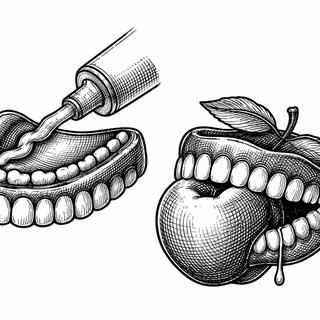
And now, a new clinical trial (NCT07496164) is putting three denture adhesive creams head-to-head - and against the brave, adhesive-free control group - to find out exactly how much bite force these products can deliver over a full 13-hour day.
Wait, We're Still Figuring Out Denture Adhesive?
I know what you might be thinking. Denture adhesive has been around since the 1930s. Surely we've got this figured out by now? Well, yes and no.
While denture adhesives are widely used and generally accepted as helpful, the actual scientific literature on how much they improve bite force - and for how long - is surprisingly thin. Most studies have measured retention (how well the denture stays put) or patient satisfaction, which are useful metrics but don't tell the whole story. Bite force is the mechanical reality check. It's the difference between "my dentures feel secure" and "I can actually chew this pretzel."
A natural dentition can generate anywhere from 150 to 250 Newtons of bite force. Denture wearers? They typically manage about 20-35% of that range. That gap is enormous, and it has real consequences for nutrition, social confidence, and quality of life. Research has consistently shown that edentulous patients tend to avoid fibrous fruits, vegetables, and proteins - not because they don't want them, but because their dentures literally can't handle the workload (Fontijn-Tekamp et al., 2000).
The Trial: Three Creams Enter, One Bite Force Reigns Supreme
This randomized, controlled, single-blind, crossover study is elegantly designed. Let me break it down.
Crossover design means every participant tests every condition. So instead of Group A getting adhesive and Group B getting nothing (and then arguing about whether Group A just had stronger jaws to begin with), each person serves as their own control. Same jaw, same dentures, different adhesive. It's the gold standard for this kind of comparison, and it makes the data substantially more reliable.
The study is evaluating three experimental denture adhesive creams against a no-adhesive baseline, measuring maximum maxillary bite force - that's the upper jaw, the one that typically gives denture wearers the most grief because gravity is not on its side. Your lower denture at least has the benefit of sitting in a trough. Your upper denture? It's basically hanging from the ceiling.
And here's the part that caught my attention: they're tracking performance over 13 hours. Most of us don't think about our teeth maintaining a performance curve throughout the day, but denture wearers absolutely do. Morning coffee? Fine. Lunch? Usually manageable. Dinner? That's when adhesives start to wave the white flag. Understanding the endurance profile of these adhesives over a full waking day is genuinely useful data.
Why This Actually Matters More Than You Think
Let's zoom out for a second. Globally, complete tooth loss affects about 7% of the population, with rates climbing sharply after age 60. The World Health Organization has flagged oral health as a major determinant of overall health and quality of life, yet it remains one of the most neglected areas of healthcare research.
Poor denture function isn't just an inconvenience. It's linked to malnutrition in elderly populations, social isolation (nobody wants to be the person whose teeth fly out at Thanksgiving), and even cognitive decline - with emerging research suggesting that reduced masticatory function may be associated with decreased cerebral blood flow and increased dementia risk (Weijenberg et al., 2019). Your jaw is doing more than chewing. It's apparently keeping your brain engaged. Evolution is wild.
A systematic review by Alqutaibi and Kaddah (2016) found that denture adhesives significantly improved both retention and patient satisfaction, but noted that standardized bite force measurements across products were lacking (doi: 10.1016/j.jds.2015.12.003). That's precisely the gap this trial aims to fill. Rather than asking patients "does this feel better?" the researchers are strapping a force gauge to their molars and getting numbers.
The Bigger Picture: Dentures Are Getting a Glow-Up
This trial arrives at an interesting moment in dental science. While implant-supported dentures have become increasingly popular (and increasingly expensive), the reality is that conventional removable dentures remain the most accessible solution for millions of people worldwide. Especially in lower-income populations and developing countries, adhesive-assisted removable dentures are often the only game in town.
Recent advances in adhesive formulation have focused on longer hold times, better resistance to saliva washout, and improved biocompatibility. Some newer formulations use polymethyl vinyl ether-maleic acid (PVM-MA) copolymers that create stronger bonds with oral mucosa while remaining easy to clean - a combination that has historically been tricky to achieve (Adisman, 1989; Grasso et al., 2004).
If this trial demonstrates that one or more of these experimental creams can maintain meaningful bite force improvement deep into the 13-hour mark, it could reshape product formulation priorities across the industry. The question shifts from "does it stick?" to "does it perform?"
So, What Should We Watch For?
The full study details - including eligibility criteria, outcome measures, and sponsor information - are available on the ClinicalTrials.gov listing (see also the table view for a structured breakdown).
What I'll be watching for when results come in:
- The 13-hour curve. Does bite force decline linearly, or is there a cliff at some point? If one adhesive holds strong at hour 10 while others have faded, that's a game-changer for evening meals.
- The magnitude of improvement. Going from 50 Newtons to 55 Newtons is statistically significant but practically meaningless. Going from 50 to 80? That's a different diet.
- Individual variation. Crossover designs help, but some mouths are just harder to fit. How consistent are the results across participants?
For the 36 million Americans - and hundreds of millions worldwide - who rely on removable dentures every single day, this kind of rigorous, product-comparative data isn't just academic. It's the difference between a denture that works and a denture that works all day.
And honestly? In a world where we're engineering mRNA vaccines and sending robots to Mars, making sure grandma can eat a corn on the cob feels like the least we can do.
Disclaimer: This article is for informational and educational purposes only and does not constitute medical or dental advice. Always consult a qualified dental professional regarding denture care and adhesive use. The clinical trial discussed is registered on ClinicalTrials.gov and results have not yet been published.
Primary Source:
ClinicalTrials.gov Identifier: NCT07496164 - "A Randomized, Controlled, Single-Blind, Cross Over Clinical Study Assessing the Maximum Maxillary Bite Force When Using Three Denture Adhesives Compared to Using No-Adhesive"
References:
1. Fontijn-Tekamp FA, et al. "Bite forces with mandibular implant-retained overdentures." J Dent Res. 2000;79(10):1563-1568. doi: 10.1177/00220345000790090801
2. Weijenberg RAF, et al. "Mastication for the mind: The relationship between mastication and cognition in ageing and dementia." J Oral Rehabil. 2019;46(5):482-494. doi: 10.1111/joor.12827
3. Alqutaibi AY, Kaddah AF. "Attachments used with implant supported overdenture." J Dent Sci. 2016;11(1):68-72. doi: 10.1016/j.jds.2015.12.003
4. Grasso JE, et al. "Effect of denture adhesive on the retention and stability of maxillary dentures." J Prosthet Dent. 2004;91(5):406-413. doi: 10.1016/j.prosdent.2004.02.025