
Why does your spinal cord even bother being so fragile? You've got bones that can survive a car crash, skin that regenerates itself every few weeks, and a liver that will forgive decades of questionable Friday night decisions. But your spinal cord - the one cable that connects your brain to literally everything below your neck - gets damaged once and basically says, "Well, that's it for me. Good luck with the wheelchair." It's arguably the worst design flaw in the human body, and honestly, the canine body too.
Which is exactly why a team of researchers decided to do something about it - not with another titanium rod or a fancier surgical clamp, but with what amounts to a biocompatible sponge loaded with stem cells. And before you roll your eyes at "stem cells" like it's 2008, hear me out, because this one actually has some interesting engineering behind it.
The Problem: Spinal Cords Don't Do Second Chances
Spinal cord injury (SCI) remains one of the most devastating diagnoses in medicine, human or veterinary. The current standard of care is depressingly mechanical: stabilize the spine, decompress whatever's being compressed, and then... wait. Maybe some physical therapy. The actual neurons that got wrecked? We mostly just hope the body figures something out, which it almost never does.
The reason is twofold. First, the central nervous system is notoriously bad at regenerating. Unlike your peripheral nerves, which can slowly regrow like reluctant houseplants, spinal cord neurons basically throw in the towel after injury. Second, even when we try to help - say, by injecting stem cells into the injury site - those cells tend to wander off or die before accomplishing anything useful. It's like hiring contractors who quit on day one because the job site is too hostile.
Enter the Scaffold: A Home for Homeless Stem Cells
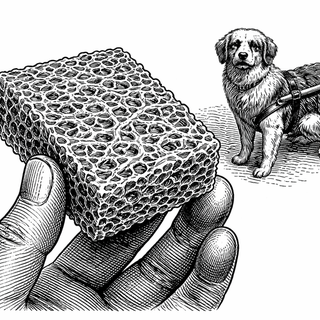
This is where the new study gets clever. Researchers developed a scaffold made from polyvinyl alcohol and chitosan (PVA/CS) - two materials that individually have well-established track records in biomedical applications. Polyvinyl alcohol is a synthetic polymer you've probably encountered in contact lens solutions and certain wound dressings. Chitosan is derived from chitin, the stuff that makes up shrimp shells and insect exoskeletons. Together, they form a three-dimensional fibrous structure that functions as a kind of apartment building for stem cells.
The idea is straightforward: instead of just dumping stem cells into a hostile injury site and hoping for the best, you give them a physical structure to cling to. The scaffold provides mechanical support, keeps cells where you actually want them, and slowly biodegrades as healing progresses. Think of it as temporary housing that dissolves once the neighborhood improves.
The team paired this scaffold with umbilical cord-derived mesenchymal stem cells (UC-MSCs), which are harvested from umbilical cord tissue and have the advantage of being relatively easy to obtain without the ethical controversies that haunt embryonic stem cell research. UC-MSCs are known for their ability to differentiate into various cell types and secrete anti-inflammatory factors - essentially, they're the helpful neighbors who bring soup when you're sick and also happen to be structural engineers.
The Experiment: 12 Dogs, 56 Days, Real Results
The researchers created spinal cord injuries in 12 canines using a balloon compression method at the T10-T11 vertebral level - a well-established model that mimics the kind of compressive injury seen in clinical SCI. The dogs were split into three groups: a control group (CD) that received no intervention, a mechanical intervention group (IM) that got surgical decompression only, and the scaffold group (SC) that received both surgical decompression and the PVA/CS scaffold loaded with UC-MSCs.
Each dog was monitored for 56 days using the canine Basso-Beattie-Bresnahan (BBB) locomotor scale - essentially a standardized way of grading how well a dog can move its hind legs, from "no observable movement" all the way up to "consistent weight-supported stepping."
The results? The scaffold-plus-stem-cell group showed statistically significant motor improvement compared to both other groups. And this wasn't just wishful scoring by optimistic researchers - the histopathological evidence backed it up. When they examined the spinal cord tissue under the microscope, the SC group showed markedly less intralesional hemorrhage (less bleeding in the injury zone) and significantly less demyelination across multiple views of the cord.
For the non-neurologists reading this: myelin is the insulating sheath around nerve fibers that allows electrical signals to travel efficiently. Losing myelin is like stripping the insulation off electrical wires - signals short-circuit, slow down, or stop entirely. Less demyelination means more intact wiring. More intact wiring means more function. It's that simple, and that significant.
Why This Matters Beyond the Veterinary Clinic
Now, twelve dogs over 56 days is not going to revolutionize medicine tomorrow. This is early-stage work, and anyone who's followed regenerative medicine knows the graveyard of promising preclinical results that never translated to human therapies is vast and well-populated.
But there are a few reasons this study is worth paying attention to. First, the canine SCI model is considerably more translatable to human injury than the rat models that dominate this field. Dogs have spinal cord anatomy and injury responses that more closely mirror our own. Second, the scaffold itself demonstrated excellent mechanical properties and biocompatibility - it's not just biologically promising, it's actually engineerable and reproducible. Third, the combination approach (scaffold plus stem cells) addresses the fundamental delivery problem that has plagued cell-based therapies for years.
The irony of spinal cord research is that we've known what we want to do for decades - regrow neurons, remyelinate axons, restore circuits. The bottleneck has always been how. You can't just throw biology at the problem and expect physics and chemistry to cooperate. This study represents the kind of interdisciplinary engineering - materials science meets cell biology meets veterinary surgery - that might actually start closing that gap.
The Road Ahead
There's still a long way to go. Larger studies, longer follow-ups, dose optimization, and eventually the treacherous leap from animal models to human trials all stand between this laboratory bench and your neurosurgeon's operating room. But for a field that has been stuck offering patients little more than stabilization and sympathy, even modest progress in actual neural regeneration is something worth watching.
And if a chitosan-and-polymer sponge loaded with umbilical cord stem cells can help paralyzed dogs regain motor function in under two months, well - maybe the spinal cord's reputation as the body's most stubbornly irreparable organ is finally due for revision.
This blog post discusses research findings and should not be taken as medical advice. If you have concerns about spinal cord injuries or neurological conditions, please consult a healthcare provider. Research discussed here represents ongoing scientific investigation and clinical validation is still in progress.
All images used in this post are decorative illustrations only and do not represent or reflect the accuracy, reality, or correctness of the referenced research.
Primary Source: Neuronal regeneration with novel polyvinyl alcohol/chitosan scaffold and stem cells in canine spinal cord injury model: from development to animal studies. PubMed: 41937574