
Spoiler alert: researchers just built a tiny chemical contraption that changes color when it detects antibiotic resistance genes in the environment, and it works so well that my first thought was "someone is going to commercialize this within five years." The device uses a metal-organic framework nanozyme paired with glucose oxidase in a cascade system that, honestly, reads like an engineering spec sheet for a startup pitch deck. Let me walk you through how they pulled it off and why your future water-testing kit might owe these scientists a royalty check.
The Problem That Won't Stop Growing
Antibiotic resistance genes, or ARGs, are essentially the cheat codes that bacteria share with each other to survive our best drugs. These genetic snippets don't just hang out in hospitals - they spread through waterways, soil, and agricultural runoff like gossip at a high school reunion. The World Health Organization has called antimicrobial resistance one of the top ten global public health threats, and detecting these genes in the environment before they become a full-blown crisis is, well, kind of a big deal.
Traditional methods for detecting ARGs - think PCR and gene sequencing - are powerful but require expensive equipment, trained technicians, and hours of processing time. That's fine for a research lab. It's terrible for a water treatment plant in rural India that needs answers by lunchtime.
Enter the Nanozyme That Does Two Jobs at Once
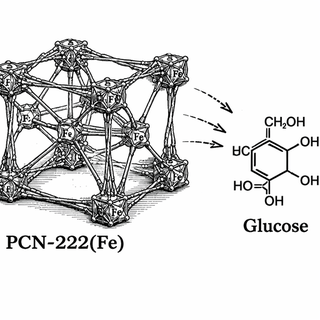
The research team developed a biosensor built around something called PCN-222(Fe), which is a type of metal-organic framework (MOF). If you haven't encountered MOFs before, imagine a molecular-scale building made of metal nodes connected by organic struts, full of perfectly sized pores and tunnels. PCN-222(Fe) specifically mimics the activity of peroxidase - an enzyme that helps break down hydrogen peroxide. It's basically a synthetic enzyme, or "nanozyme," that never gets tired and doesn't need a salary.
But here's where the engineering gets clever. The team took glucose oxidase (GOx) - a natural enzyme that converts glucose into hydrogen peroxide - and stuffed it inside the mesoporous channels of the PCN-222(Fe) framework. Now you've got a two-step cascade reaction living under one roof: GOx produces hydrogen peroxide from glucose, and the MOF immediately uses that hydrogen peroxide in a color-producing reaction. No intermediate product wasted. No signal lost in transit. It's like putting the kitchen and the dining room in the same tiny apartment - everything stays hot.
The DNA Trigger: Where Biology Meets Diagnostics
A color-changing nanozyme is neat, but it's useless for detecting specific genes unless you can aim it at the right target. The researchers solved this by functionalizing their system with oligonucleotides - short, custom-designed DNA strands that act like molecular Velcro.
Here's the workflow: when the target ARG is present in a sample, it hybridizes with the probe DNA strands, which triggers assembly of what the researchers call a "bridged cascade system." Essentially, the DNA recognition event physically brings the GOx and the PCN-222(Fe) nanozyme into close proximity, creating an efficient relay where the glucose oxidase product feeds directly into the peroxidase mimic. When the target gene isn't there, the cascade doesn't assemble, and the color doesn't change. It's a molecular on/off switch, and it's elegant.
The Numbers That Make Investors Pay Attention
The biosensor showed a linear detection range of 0-100 nanomolar for the target gene, with strong correlation (the abstract mentions R-squared values that would make a statistician smile). For context, nanomolar sensitivity means you're detecting vanishingly small amounts of genetic material - we're talking about finding a specific needle in a haystack the size of a swimming pool.
What makes this commercially interesting isn't just the sensitivity. It's the simplicity. Colorimetric detection means you can literally see the result with your eyes. No fluorescence microscope. No PCR machine. No $200,000 sequencer humming in the corner. The readout is a color change, which could theoretically be quantified with a smartphone camera and a simple app. That's the kind of thing that scales from research labs to field deployment faster than you can say "Series A funding."
Why This Matters Beyond the Lab Bench
Let's think about the market for a second. Environmental monitoring for ARGs is a growing regulatory priority. The European Union, the EPA, and public health agencies worldwide are increasingly concerned about antimicrobial resistance spreading through environmental reservoirs. A rapid, low-cost, field-deployable test for resistance genes would find customers in water utilities, agricultural monitoring, wastewater treatment facilities, and environmental consulting firms.
The cascade approach also has legs beyond ARG detection. The same architecture - DNA-triggered proximity-based enzyme cascade on a nanozyme scaffold - could be adapted for detecting virtually any nucleic acid target. Swap out the probe sequences, and you've got a platform technology, not a one-trick pony. Viral RNA in wastewater surveillance? Pathogen DNA in food safety testing? The framework is modular enough to make a product manager weep with joy.
The Challenges Ahead
Before anyone starts drafting term sheets, there are real hurdles. Moving from buffer-solution experiments to complex environmental matrices (river water, soil extracts, sewage) is notoriously difficult. Real-world samples contain interferents that love to gum up biosensor performance. The team will need to demonstrate robustness across diverse sample types.
Manufacturing consistency is another question. MOF synthesis at scale is an active area of materials science research, and getting batch-to-batch reproducibility for a commercial diagnostic product is a different beast than making it work in a university lab.
Storage stability matters too. Enzymes, even encapsulated ones, can degrade over time. A field-deployable test needs shelf life measured in months, not days.
The Bottom Line
This research represents exactly the kind of platform innovation that bridges the gap between academic cleverness and real-world utility. A colorimetric, nanozyme-based biosensor for antibiotic resistance genes that works through DNA-triggered cascade catalysis? That's not just a paper. That's a pitch deck waiting to happen.
The combination of high sensitivity, visual readout, and modular design puts this technology squarely in the sweet spot between "scientifically impressive" and "commercially viable." If the team can nail the translation from lab bench to field kit, they'll be sitting on something that environmental regulators and public health agencies will be lining up to buy. And in a world where antibiotic resistance is racing ahead of our ability to track it, we could use a few more tools that don't require a PhD to operate.
This blog post discusses research findings and should not be taken as medical advice. If you have concerns about antibiotic resistance or environmental contamination, please consult a healthcare provider or environmental health specialist. Research discussed here represents ongoing scientific investigation and clinical validation is still in progress.
All images used in this post are decorative illustrations only and do not represent or reflect the accuracy, reality, or correctness of the referenced research.
Primary Source: A target-triggered cascade colorimetric biosensor based on PCN-222(Fe)/GOx nanozyme for rapid detection of antibiotic resistance genes. PubMed. 2026. PMID: 41932244